Top 10 Types of Pipe Fittings for Global Buyers
Pipe Fittings are small components with large consequences. An elbow redirects flow, a tee divides it, and a reducer balances changing pipe diameters. In a refinery, one imperfect connection can create vibration, leakage, or costly downtime. Buyers therefore need more than a product list. They need evidence about pressure ratings, material grades, dimensions, corrosion resistance, and manufacturing standards.
Market estimates show why this topic matters. Grand View Research valued the global pipe fittings market at approximately USD 15.4 billion in 2023 and projects continued growth through 2030. Fortune Business Insights reports a different 2023 valuation, near USD 15.7 billion. The gap reflects different definitions and research methods. Numbers are useful, but not perfect. Procurement teams should verify them against project requirements and regional supply conditions.
Mohinder L. Nayyar, author of Piping Handbook, defines piping as “a system of pipes, fittings, valves, and other components” used to transport fluids. That practical definition still guides industrial selection. The right fitting must match the medium, temperature, pressure, joining method, and installation environment. Stainless steel may suit corrosive service, while carbon steel can offer a lower-cost option for suitable applications. Not every popular fitting suits every project.
This guide examines ten widely used Pipe Fittings, including elbows, tees, couplings, unions, reducers, caps, crosses, and flanges. Each type has a distinct role. Some choices look interchangeable. They are not. Real-world performance depends on design details, certified materials, dimensional accuracy, and installation quality.
Pipe Fittings: Definition, Functions, and Global Applications
Top 10 Types of Pipe Fittings for Global Buyers
Pipe Fittings: Definition, Functions, and Global Applications
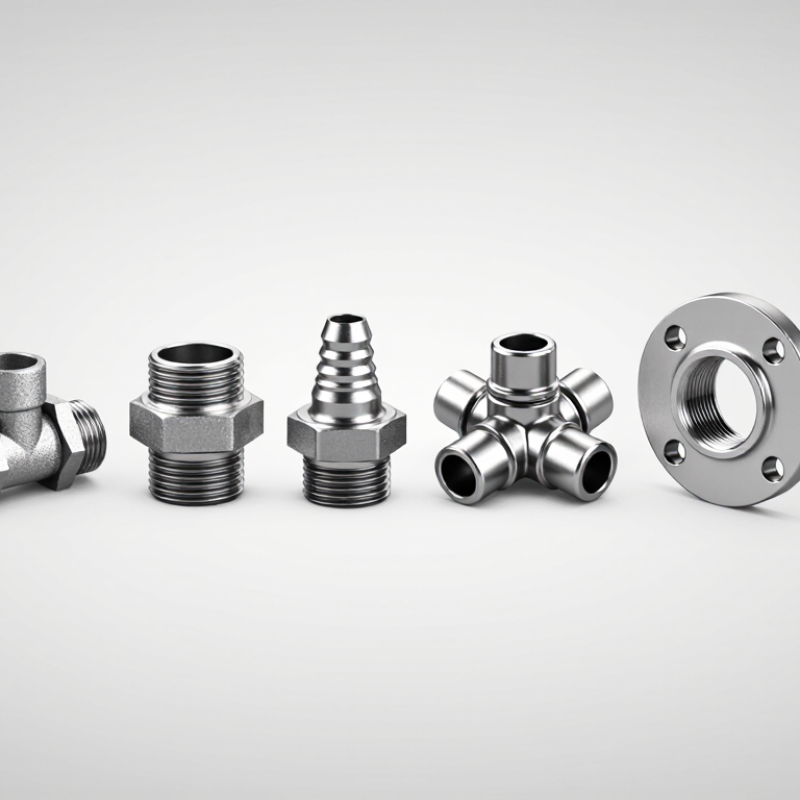
Pipe fittings are components that join, redirect, control, or close piping systems. Common types include elbows, tees, reducers, couplings, unions, caps, plugs, crosses, nipples, and flanges. Each type solves a different installation problem. Elbows change flow direction, while reducers connect pipes with different diameters. Tees divide flow into separate lines. Flanges support maintenance because workers can disconnect sections without cutting the pipe.
These fittings serve water treatment, chemical processing, energy, construction, and manufacturing facilities worldwide. Material selection depends on pressure, temperature, fluid properties, and corrosion risks. Stainless steel may suit aggressive environments, while carbon steel often serves general industrial lines. Threaded fittings can simplify small-system repairs. Welded connections usually offer stronger sealing for demanding service. A fitting that looks correct can still fail. Wall thickness, dimensional tolerance, and applicable standards require careful checking. This process is not perfect, especially when drawings lack field measurements.
Tips: Confirm pipe size, schedule, pressure rating, and connection method before purchasing. Request inspection records and material certificates from reliable suppliers. Check sealing surfaces for scratches, rust, or uneven machining. Store fittings with protective covers. Even experienced teams sometimes overlook temperature changes, which can weaken an otherwise suitable connection.
Top 10 Pipe Fitting Types and Their Structural Differences
Top 10 Types of Pipe Fittings for Global Buyers
Top 10 Pipe Fitting Types and Their Structural Differences
Pipe fittings differ mainly by shape, connection method, and flow purpose. Elbows use a curved body to redirect fluid, commonly at 45 or 90 degrees. Tees add one branch to a straight pipeline, while crosses create four connection points. Their internal passages can increase turbulence, especially when branches meet sharply. Reducers connect different pipe diameters. Concentric reducers keep both centerlines aligned, while eccentric reducers shift one side to support drainage or prevent air pockets.
Couplings have two joining ends and usually connect pipes of equal diameter. Nipples are shorter, often threaded sections used between fittings or equipment. Unions contain separate mating parts, allowing maintenance without rotating the connected pipe. Flanges use flat faces, bolt holes, and a gasketed joint. This structure supports repeated disassembly, but bolt alignment and gasket compression require careful control. Caps close pipe ends, while plugs close fittings or smaller openings from inside the connection.
In practical purchasing, the visible shape is only part of the decision. Check wall thickness, bore size, end type, pressure rating, and material compatibility. A socket-weld fitting is not interchangeable with a threaded fitting, even when dimensions appear similar. Field inspection often reveals mismatched standards or rough internal edges. These small defects may disturb flow and complicate installation. I have found that catalog drawings can simplify geometry too much. Buyers should request dimensional tables, inspection records, and clear tolerances before approving production.
Top 10 Types of Pipe Fittings for Global Buyers
Structural comparison based on the number of pipe connection ports in a typical fitting design.
How to read the chart: The number of ports helps distinguish the basic structure of each fitting. Elbows, reducers, couplings, unions, adapters, and nipples normally connect two pipe ends. Tees and crosses branch flow into three or four directions, while caps and plugs close a pipe opening.
Key structural differences: Elbows change flow direction, tees and crosses divide flow, reducers change pipe size, couplings and unions join straight sections, adapters transition between connection standards, nipples provide a short male-threaded extension, and caps or plugs terminate a pipe system.
Materials, Standards, Sizes, and Connection Methods
Top 10 Types of Pipe Fittings for Global Buyers
Materials, standards, sizes, and connection methods determine whether a fitting performs reliably in service. Common choices include elbows, tees, reducers, caps, couplings, unions, crosses, nipples, flanges, and stub ends. Elbows redirect flow, while tees create branches. Reducers connect different pipe diameters. Caps close unused lines. Unions support easier maintenance. Flanges simplify equipment connections, but stub ends often reduce material costs.
Material selection should match pressure, temperature, fluid chemistry, and corrosion exposure. Carbon steel suits many industrial systems, while stainless steel performs better in aggressive environments. Ductile iron and plastic fittings can serve water or low-temperature applications. Sizes may follow DN or NPS systems, with schedules defining wall thickness. A 2-inch pipe is not always dimensionally identical across standards.
Connection methods include butt welding, socket welding, threaded ends, flanged joints, grooved couplings, and solvent cement. NPT, BSPT, ASME, ASTM, ISO, and EN requirements may differ in thread form, dimensions, and testing. Check the complete project specification, not only the product drawing. A clean catalog match can still fail during installation. In field checks, thread direction, flange facing, gasket type, and actual wall thickness deserve attention. Small mistakes happen. They are expensive to correct later. Suppliers should provide material certificates, dimensional reports, pressure ratings, and traceable inspection records before shipment.
How Global Buyers Compare Quality, Cost, and Supplier Reliability
Top 10 Types of Pipe Fittings for Global Buyers
Global buyers often compare elbows, tees, reducers, couplings, unions, caps, crosses, adapters, nipples, and flanges. The fitting type matters, but quality decisions require closer inspection. Check material grade, wall thickness, dimensions, thread accuracy, and surface condition. A 90-degree elbow with uneven welds may create installation delays and leakage risks. A reducer with poor concentricity can disturb flow and increase stress on connected pipes.
Cost should include more than the unit price.
Compare machining quality, testing fees, packaging, freight, and replacement risks. Ask suppliers for inspection reports, material certificates, pressure-test records, and sample measurements. For threaded fittings, verify gauge results and thread protection. For flanges, inspect drilling patterns, face finish, and bolt-hole alignment. Small details matter.
Supplier reliability is harder to measure.
Review production capacity, response speed, quality-control procedures, and delivery history. Request a sample order before committing to large volumes. Clear drawings reduce misunderstandings. So does written approval of tolerances.
We have seen attractive quotations fail when packaging allowed fittings to rub against each other during transport. That lesson is easy to overlook. A supplier may provide excellent samples but inconsistent bulk production. Regular inspections can expose that gap, although inspections also add time and cost. No checklist is perfect. Buyers should keep questioning assumptions, especially when a price seems unusually low.