How to Understand Flange Standards for Optimal Industrial Applications?
Understanding flange standards is crucial for optimal industrial applications. These standards ensure compatibility and safety in various sectors, including oil, gas, and manufacturing. Flange standards encompass various specifications and dimensions that dictate how flanges should be designed and used. They help prevent leaks and failures, which can lead to costly downtime.
Many professionals encounter difficulties in navigating these standards. There are numerous codes, like ASME and ISO, each with specific requirements. This complexity can confuse even seasoned engineers. Misinterpretation might lead to selecting the wrong flange type for an application, jeopardizing project integrity.
It’s essential to grasp the basics of flange standards to avoid frustration. Understanding how flange types, materials, and pressure ratings intersect can greatly improve selection processes. Real-world applications often reveal gaps in knowledge that need careful reflection. Professionals should continually educate themselves on industry advancements. Building a solid foundation in flange standards will enhance reliability and efficiency in their work.
Understanding Flange Types: An Overview of Common Standards
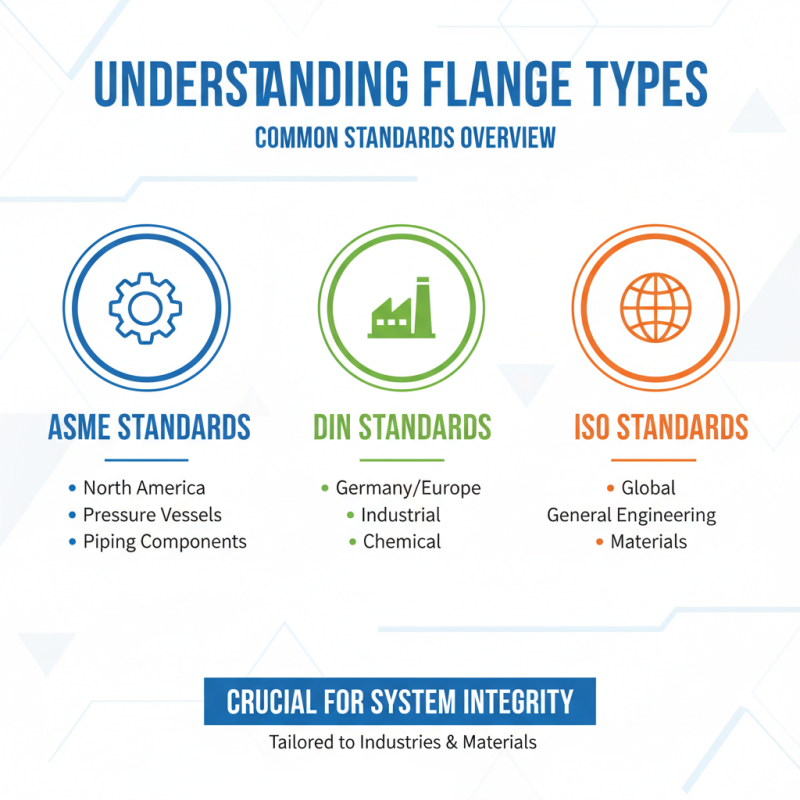
Flanges are essential components in various industrial applications. Understanding flange types and their associated standards is crucial for ensuring system integrity. Common standards include ASME, DIN, and ISO. Each standard is tailored to specific industries and materials.
ASME flanges are widely used in North America. They provide guidance on dimensions, tolerances, and pressure ratings. The ASME B16.5 standard is particularly prevalent, offering specifications for sizes up to 24 inches. In contrast, DIN standards are more common in Europe. The DIN 2573 standard categorizes flanges based on pressure ratings and temperature conditions.
According to a report by Research and Markets, the global flange market is expected to grow at a CAGR of 4.5% over the next five years. This data highlights the increasing demand for reliable flanging solutions in sectors such as oil and gas, water treatment, and manufacturing. However, the existence of various standards can lead to confusion. Engineers must take care when selecting flanges to prevent mismatched components and potential failures. The importance of understanding the specific application requirements cannot be overstated.
Key Material Specifications for Industrial Flanges and Their Applications
Flanges are critical components in industrial applications. They connect pipes and prevent leaks. Understanding material specifications is vital for effectiveness. The American Society of Mechanical Engineers (ASME) provides guidelines that many industries follow. Common materials include carbon steel, stainless steel, and alloy steel. Each has unique properties that affect performance.
Carbon steel flanges are often used in low-pressure applications. They offer good strength and are cost-effective. However, they can corrode if not properly treated. Stainless steel flanges resist corrosion well. This makes them ideal for high-pressure and high-temperature environments. According to a recent industry report, stainless steel accounts for over 50% of the flange market.
Alloy steel flanges serve specialized needs. They are designed for extreme conditions and provide high tensile strength. Yet, they are typically heavier and more expensive. Organizations must assess their specific requirements. This includes pressure levels, temperature variations, and environmental factors. The right choice prevents failures and ensures operational efficiency. Engineers often overlook the need for thorough material analysis. Neglecting this can lead to costly mistakes and downtime.
Dimensional Tolerances in Flange Standards: Importance and Impact
When dealing with flanges in industrial applications, understanding dimensional tolerances is crucial. These tolerances determine the fit and function of flanges, significantly impacting the overall system's performance. Minor discrepancies in dimensions can lead to issues such as leaks or improper alignment. For instance, a tolerance that is too loose may cause a flange to wobble, creating unnecessary stress. On the contrary, overly tight tolerances can make installation difficult and time-consuming.
Moreover, the importance of adhering to established standards cannot be overstated. Industrial projects often rely on these standards to ensure compatibility and reliability. Engineers might assume that all flanges are created equal. However, variations can arise from manufacturing processes and material choices. Even slight deviations from the dimensions can lead to unforeseen complications during assembly. Therefore, it’s essential to pay close attention to specified tolerances when selecting flanges for any project.
An inadequate understanding of these parameters can lead to wasted resources. Workers may need to rework or replace components that do not meet the required specifications. The financial impact of these mistakes can be significant. Hence, investing time in understanding flange standards is vital for efficient industrial applications. Manufacturers and engineers should focus on achieving precise measurements and regular quality checks to mitigate potential problems.
Pressure Ratings in Flanges: A Guide to ANSI and ASME Standards
When selecting flanges for industrial applications, understanding pressure ratings is crucial. ANSI and ASME standards provide essential guidelines. ANSI (American National Standards Institute) focuses on establishing consistency across various industries. On the other hand, ASME (American Society of Mechanical Engineers) emphasizes safety and performance in design.
Pressure ratings are categorized into classes. Common examples include Class 150 and Class 300. Each class indicates the maximum pressure a flange can handle at a specific temperature. For instance, a Class 150 flange can typically manage pressures up to 285 psi at a temperature of 100°F. This clarity helps in making informed decisions regarding material and size.
Despite their importance, many professionals overlook the specific requirements of their applications. This can lead to costly errors. Always verify the compatibility of pressure ratings with the system's needs. Relying solely on ratings without understanding the broader context can result in failures. Engaging with experienced engineers can provide valuable insights. It ensures the choice of flanges is not just based on standards but also on practical application and evaluation.
Quality Assurance and Testing Methods for Flange Compliance
Understanding flange standards requires a focus on quality assurance. Compliance with these standards is crucial in various industries, from manufacturing to construction. Flanges must meet specific criteria to ensure safety and efficiency. The testing methods used to verify flange compliance play a pivotal role.
Visual inspection serves as an initial check. Inspectors look for imperfections like surface flaws and misalignments. However, this method does not catch all issues. Non-destructive testing (NDT) is essential for a deeper analysis. Techniques like ultrasonic and radiographic testing reveal internal defects that could compromise performance. This technology allows for a thorough evaluation without damaging the flange.
Documentation of testing results is critical. It builds trust with stakeholders and demonstrates compliance with industry standards. However, discrepancies in reports can occur. Regular audits and recalibrations are necessary to maintain accuracy in testing. By focusing on these quality assurance methods, industries can optimize their flange applications effectively.