Who Are the Top Diamond LED Display Manufacturers in China?
A Diamond Led Display can turn a plain wall into a striking feature, but its angled modules demand careful engineering. Small alignment errors show quickly along the edges. For buyers comparing manufacturers in China, the key question is not simply who offers the lowest quote. It is who can demonstrate consistent production, dependable support, and a design suited to the installation.
This guide examines manufacturers through practical criteria: module dimensions, pixel pitch, cabinet construction, brightness, refresh rate, and access for maintenance. These details matter in a retail window, an event venue, or a control room, where viewing distance and ambient light differ. Ask for close-up photos of seams, test footage, and a clear explanation of warranty coverage. Better still, review a working sample. Specifications alone can look reassuring.
There is no universal ranking for every project. A supplier strong in custom shapes may not be the best fit for a large, standard-format screen. Company claims also deserve verification; polished images do not prove long-term performance. The following overview helps readers compare Chinese manufacturers more carefully, identify useful questions, and judge whether a proposed display matches their real operating needs. Some details may remain uncertain until the design, budget, and site conditions are known. That is worth admitting.
What Is a Diamond LED Display?
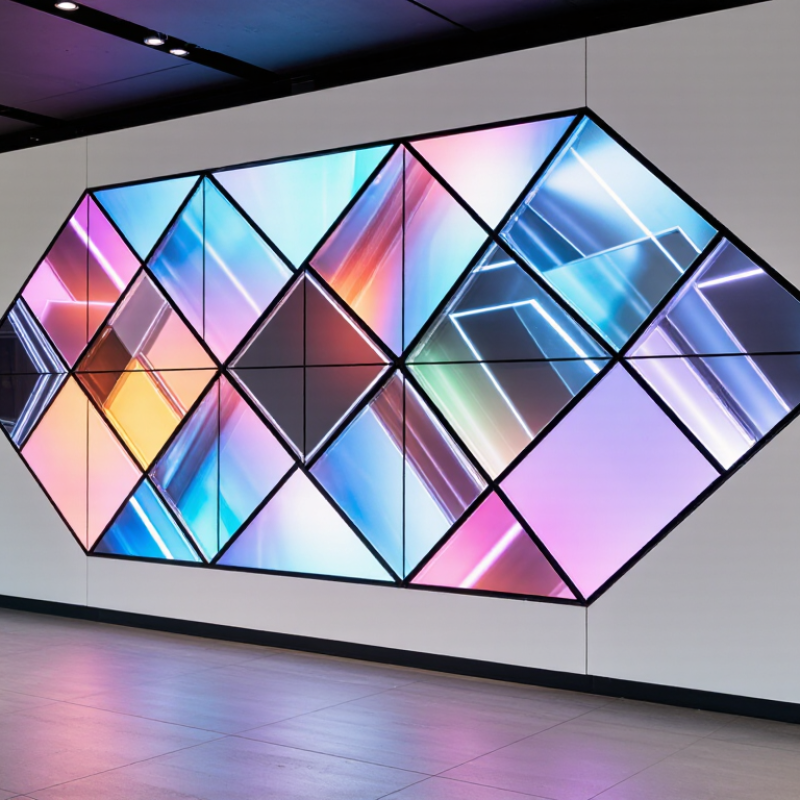
A diamond LED display is a screen built from diamond-shaped modules or cabinets, rather than a conventional rectangle. When joined, the panels form repeating facets that can create a large geometric surface. Some installations use the shape as a frame around a central screen; others fill the entire surface with video. The exact design varies, so the term can be confusing.
Small details matter. Pixel pitch affects how clearly text and fine patterns appear from a given distance. Cabinet alignment also matters: even a slight gap can interrupt a diagonal line. Technicians typically map the modules in the display controller and calibrate brightness and color across the facets. Viewing angle, refresh performance, and access to power and data connections should be checked before installation. A close inspection helps.
Diamond shapes can make content feel dynamic, but they are not ideal for every message. Standard video may be cropped or distorted at the edges, and replacement modules can be harder to match than rectangular ones. In practice, a simple test pattern often reveals issues that a glossy rendering hides. The result can look striking. It can also be awkward. Planning around the actual viewing distance and content usually matters more than choosing an unusual outline.
How Diamond LED Displays Are Designed and Manufactured
Designing a diamond LED display starts with geometry, not the screen surface. Engineers map the viewing angle, pixel pitch, and mounting points in CAD, then divide the shape into serviceable modules. Each edge must meet cleanly; even small angle errors can create visible seams. The PCB layout also needs room for connectors, power routing, and heat dissipation. Tight corners are tricky. A useful design review checks both the front view and rear access before tooling begins.
Manufacturing typically combines LED sorting, surface-mount assembly, cabinet construction, and image calibration. Binned LEDs help maintain consistent color across panels, while thermal tests reveal hotspots before installation. MarketsandMarkets estimated the global LED display market at US$7.1 billion in 2023, with a forecast of US$12.3 billion by 2028. TrendForce’s 2024 LED display outlook estimated a US$7.56 billion market for that year. These figures use different market scopes, so they are not directly interchangeable. They do show why repeatable production matters. Calibration still needs judgment: a technically uniform screen can look uneven when viewed from an off-center position. That detail is easy to miss.
What Defines a Leading Diamond LED Display Manufacturer?
A leading diamond LED display manufacturer understands that angled edges change more than appearance. Each cabinet must align cleanly, with consistent gaps and stable support at every joint. Details matter. Ask for close-up photos of corners, seams, and installed displays, not only polished renderings. A useful sample should show how the pixels look from several viewing distances and angles. Check brightness uniformity, color calibration, refresh performance, and whether replacement modules match the original image.
Manufacturing quality also shows in the process behind the screen. Look for documented inspection steps, burn-in testing, and checks for heat buildup during extended operation. The supplier should explain pixel pitch, module dimensions, control systems, and installation requirements in clear terms. Experience with non-standard geometry is valuable, but past projects alone are not proof of consistent quality. Request technical drawings and a realistic maintenance plan. Fit matters. Spare parts, repair access, and responsive technical support can affect the display long after installation. No supplier gets every detail right; what matters is how clearly they identify limitations and resolve problems.
What Defines a Leading Diamond LED Display Manufacturer?
Pixel pitch is one useful specification when comparing LED displays. This chart shows the theoretical pixel density for square pixel grids at common pitches, calculated as (1,000 ÷ pitch in mm)². It is a technical comparison, not a manufacturer ranking; actual display layouts may differ.
When evaluating a manufacturer, also check pixel uniformity, calibration, reliability testing, warranty terms, and after-sales support.
Who Are the Leading Diamond LED Display Manufacturers in China?
China’s leading diamond LED display manufacturers are not defined by shape alone. They combine LED module production, cabinet engineering, control-system integration, and dependable project support. Strong candidates can explain pixel pitch, viewing distance, brightness, and maintenance access in plain terms. That clarity is useful.
Ask how the diamond geometry is built: are modules custom-made, or are standard panels arranged with masked edges? Request drawings, a sample corner, and close-up photos of seams. Inspect color consistency at low brightness, black levels, and front-service access. Details matter. A polished showroom can hide uneven joints or awkward cable routing.
Reliable suppliers should provide factory test records, burn-in procedures, spare-part plans, and realistic lead times. Check who handles calibration and commissioning, not only who sells the screen. Warranty terms matter, but response times and replacement-module availability matter in daily operation. Some specifications look impressive on paper; ask for measured results from a comparable installation. No manufacturer suits every venue. Match engineering capability to display size, viewing angle, and operating schedule.