
China Top 10 Wine Refrigerator Manufacturers

A Wine Refrigerator is more than a small cabinet with a glass door. It controls temperature, limits light exposure, and helps protect bottles from daily kitchen fluctuations. The opportunity is practical, not purely decorative. The International Organisation of Vine and Wine (OIV), in its 2024 State of the World Vine and Wine Sector report, estimated global wine consumption at 221 million hectolitres in 2023, down 2.6% from 2022. That figure does not measure refrigerator sales, but it shows the scale of the wine market these manufacturers serve.

For a useful comparison, buyers need more than polished product photographs. Compressor performance, temperature consistency, vibration control, usable shelf spacing, and after-sales support all deserve attention. Wine educator and author Jancis Robinson’s published guidance on storage can be paraphrased simply: protect wine from heat, light, and unstable conditions. That is a practical test for any appliance. A quiet unit beside a dining table may suit one home; a larger cellar-style model may suit a restaurant or collector. The right choice depends on the bottles and the room.

This ranking examines ten China-based manufacturers through those everyday considerations, alongside product range and market presence. It is not a laboratory test, and specifications can change between models. Some claims also deserve closer verification. Readers should check current technical sheets before purchasing. A low price can look convincing. Reliable temperature control matters more.
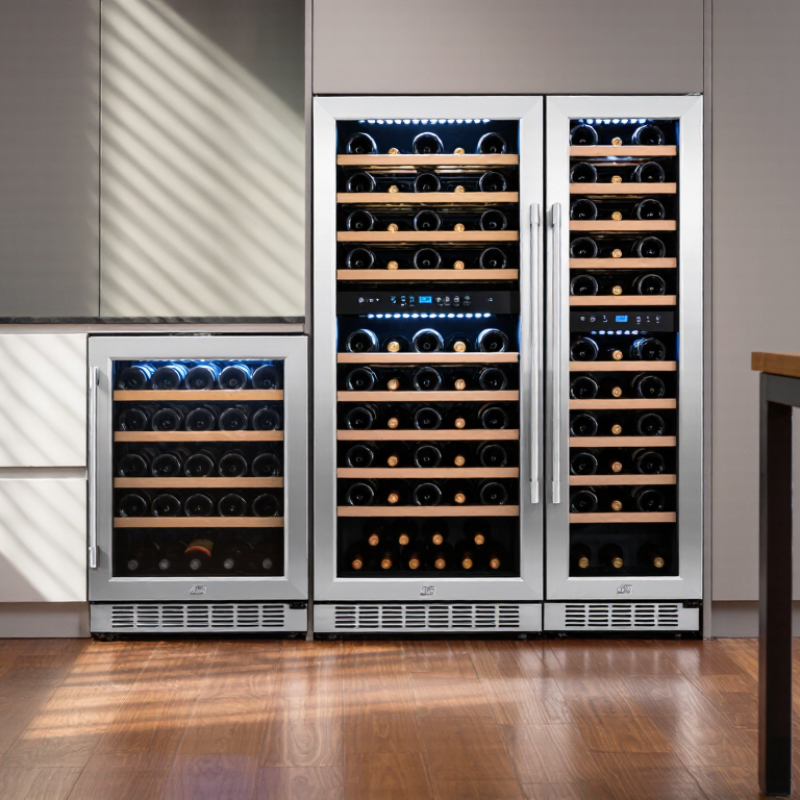
China Top 10 Wine Refrigerator Manufacturers

Wine Refrigerator Manufacturing in China: Industry Overview

China’s wine refrigerator manufacturing industry combines cabinet fabrication, insulation, cooling systems, glass-door assembly, and electronic controls. Production ranges from compact countertop units to larger built-in cabinets. Many factories can adjust dimensions, shelving, finishes, and control panels for export orders. Yet customization does not guarantee consistent quality. Buyers should verify production capabilities rather than rely on product catalogs alone.

Temperature stability, vibration, humidity management, and light protection shape real-world performance. A unit may look refined but struggle when room temperatures fluctuate or doors open often. Reliable manufacturers can explain compressor selection, insulation thickness, airflow design, and testing procedures clearly. Ask for test records and inspect samples under operating conditions. Small details matter. Shelf spacing, seal alignment, and condensation control can affect daily use. Factory audits and clear warranty terms also help assess supplier reliability.

Tips: Match capacity to the number and size of bottles you store. Confirm ventilation clearance, voltage, noise levels, and installation dimensions before ordering. Request sample testing for temperature recovery after repeated door openings. Compare delivered units with approved specifications, especially shelves, glass, and controls. One imperfect detail can reveal a process gap, so leave room for follow-up questions.

China Wine Refrigerator Manufacturing: Temperature Design Reference

Common serving-temperature ranges by wine style can help inform single- and multi-zone refrigerator designs.

Ranges shown are general serving guidance, not market-share or manufacturing-output data. Preferences and recommendations may vary by wine.

How the Top Ten Manufacturers Are Identified

Identifying the top ten wine refrigerator manufacturers requires more than comparing catalog claims. The assessment should begin with documented product performance. Test units can be monitored with calibrated probes at several shelf positions. Record temperature swings, recovery after door openings, and differences between upper and lower shelves. A quiet showroom is not enough. Check noise and vibration during normal compressor cycles, and measure energy use over repeated operating periods. These details show how a cabinet may perform in everyday settings.

Manufacturer selection should also consider build quality, production consistency, and after-sales support. Reviewers can inspect door seals, shelf movement, interior finishes, and the stability of the cabinet during operation. Factory audits and quality-control records add useful evidence when they are available. Repair rates, warranty terms, and access to replacement parts can help indicate long-term reliability. No single metric tells the whole story. Rankings should explain their testing methods, evidence sources, and review dates, rather than treating promotional specifications as proof. Some records remain incomplete. That limitation should be stated plainly, since results can change with new models, service data, or testing conditions.

China Top 10 Wine Refrigerator Manufacturers - How the Top Ten Manufacturers Are Identified

This table presents a transparent evaluation framework for identifying and comparing eligible manufacturers. The weights are suggested assessment criteria, not verified scores or a published ranking. Each candidate should be evaluated using current, independently checkable evidence.

Evaluation Dimension Weight Evidence to Review Scoring Guide
Wine Refrigerator Product Focus 15% Product catalogs, technical specifications, and evidence of dedicated wine-storage models rather than general cooling products alone. Score higher for a clearly developed wine-refrigerator range with documented specifications and product support.
Manufacturing Capability 15% Factory or production-process documentation, quality-control procedures, production equipment, and traceable manufacturing information. Score higher when manufacturing arrangements and quality-control processes can be independently verified.
Product Quality and Compliance 12% Applicable product test reports, safety and energy documentation for target markets, inspection records, and documented corrective-action processes. Score higher for current, relevant documentation that can be matched to the specific product models being assessed.
Temperature Control and Stability 12% Published temperature ranges, temperature-uniformity test results, control-system specifications, and operating-condition information. Score higher when performance claims are supported by test methods, measurable results, and clearly stated operating conditions.
Product Range and Configuration 10% Documented choices in storage capacity, installation type, temperature zones, shelving, dimensions, and cooling configurations. Score higher for a useful, clearly specified range that addresses different installation and storage requirements.
OEM and ODM Readiness 10% Documented customization options, engineering support, product-development process, sample procedures, and change-control practices. Score higher when customization capabilities and project processes are supported by specific, verifiable information.
Export and Market Experience 8% Verifiable export documentation, experience serving relevant destination markets, and product documentation prepared for those markets. Score higher for evidence of sustained, relevant export activity; unverified marketing claims should not receive full credit.
Warranty and After-Sales Support 7% Written warranty terms, spare-parts availability information, service procedures, and processes for handling product issues. Score higher for clear, accessible terms and documented support arrangements.
Energy and Environmental Information 6% Energy-consumption data, refrigerant information, and applicable environmental or efficiency documentation for the intended market. Score higher when relevant claims are specific, current, and supported by product-level evidence.
Information Transparency 5% Consistency of product specifications, technical documents, business information, and responses to verification requests. Score higher when key information is complete, consistent, and readily verifiable.
Total Suggested Weight 100% Rate each dimension on a 0–5 scale. Calculate the weighted result as: dimension score ÷ 5 × dimension weight. Compare only candidates assessed using the same evidence standard.

Profiles of Ten Leading Chinese Wine Refrigerator Manufacturers

China’s wine refrigerator sector includes manufacturers with different strengths, from compact thermoelectric cabinets to larger compressor-cooled units. The ten profiles compare practical factors: temperature-zone design, stated capacity, insulation, production flexibility, and after-sales support. Details matter. A showroom sample may look quiet, but long-term noise and temperature stability need testing under real operating conditions.

Grand View Research’s 2024 wine cooler market report estimated global market value at about US$2.3 billion in 2023, with projected growth through 2030. This outlook helps explain why Chinese suppliers are expanding export-ready product ranges, but market growth does not prove any single factory’s quality. Buyers should request temperature-uniformity results, energy-use data, and cabinet specifications, then check whether the figures apply to the exact model. One limitation deserves notice: public reports rarely separate Chinese wine refrigerator output from broader cooling-appliance production. The profiles therefore focus on verifiable product and manufacturing capabilities, not an unsupported ranking. A careful comparison is less tidy, but more useful.

Products, Technologies, and Manufacturing Capabilities

China’s wine refrigerator manufacturers produce compact under-counter units, tall freestanding cabinets, and larger models for restaurants or collectors. Product differences go beyond capacity. Buyers should compare shelf spacing, door swing, lighting, and whether bottles can be stored at an angle. These details matter when a cabinet must fit a narrow kitchen opening or hold wider sparkling-wine bottles.

Temperature control is a key technology. Many units use compressor cooling, while some smaller models use thermoelectric systems. Check how steadily a cabinet maintains its set temperature, especially during warm-room testing. Quiet operation and low vibration also deserve attention. Not every specification tells the full story.

Look closely at manufacturing capabilities, not just catalog claims. Established factories may use insulation foaming, leak testing, electrical checks, and temperature-cycle testing on production lines. Ask how each check is recorded and whether sample units match the final order. A useful inspection includes door seals, shelf movement, display readings, and the cabinet’s recovery after opening. Small flaws show up here. Documentation can still be uneven, so request clear test criteria, material details, and realistic lead times before comparing suppliers.

Comparing Manufacturers by Quality, Capacity, and Market Reach

Comparing China’s leading wine refrigerator manufacturers works best when quality is measured beyond appearance. Inspect cabinet insulation, door seals, shelf movement, and temperature stability during repeated opening. Ask for test records under the ambient conditions expected in use, not just a single factory reading. A quiet compressor matters in a dining room, while vibration control can help protect stored bottles. Small details count. Still, polished samples may hide uneven production, so request batch-level checks and clear warranty terms before treating a specification sheet as proof.

Capacity should match the setting, not the marketing photos. A compact unit may suit a home collection, while restaurants need usable shelf spacing, quick temperature recovery, and replaceable parts. Compare stated bottle counts carefully; bottle shapes and shelf layouts change real capacity. Market reach means more than export destinations. Check for installation guidance, spare-part availability, clear documentation, and responsive regional support. Broad distribution can help, but distance may still slow repairs. There is no perfect scorecard. Record sample performance, lead times, and after-sales commitments in one table, then weigh the trade-offs against the project. It is less tidy than a ranking, but often more useful.

Get In Touch

Drop Us A Message

    Our Contact Details

    • IPS Group BV | Head Office (NB), Technopol 4, 5026 SB Tilburg, The Netherlands

      IPS Group BV | Rhijnspoor 239, 2901 LB Capelle a/d IJssel, The Netherlands
    • sale@qbhardware.org
    • +31 (0) 10 303 2625