China Top 10 FRP Rectangular Tube Manufacturers
China has a broad market for pultruded composite profiles, including structural tubing used in industrial and infrastructure projects. A Frp Rectangular Tube can offer corrosion resistance, electrical insulation, and lower weight than many metal alternatives. These features matter around chemical equipment, walkways, cable supports, and outdoor structures. Still, performance depends on the resin system, reinforcement, dimensions, and production control—not just the product name.
This guide introduces ten Chinese manufacturers for buyers comparing suppliers. Useful checks include profile size tolerances, glass-fiber content, resin options, load data, sample availability, and documented quality procedures. Ask how the tube performs under the temperature, moisture, and chemical conditions of your project. Clear answers and technical drawings are more helpful than broad claims. Small details count.
The companies in a market overview may differ in specialization, export experience, and customization capacity. Treat any shortlist as a starting point, not a substitute for checking current product specifications and communicating directly with suppliers. Catalog information can be incomplete, and a familiar profile may not suit every installation. That caveat is worth keeping in mind. Compare evidence, request relevant test reports, and confirm dimensions before ordering. This approach helps readers identify manufacturers whose capabilities align with real project requirements.
Understanding FRP Rectangular Tubes and Their Key Properties
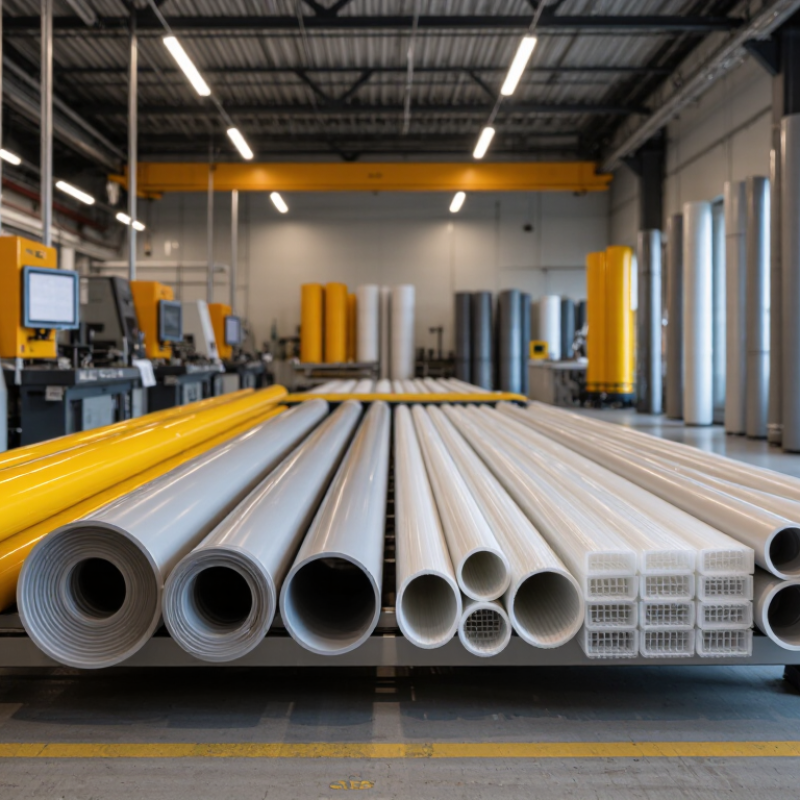
FRP rectangular tubes combine glass fibers with a polymer resin in a hollow, four-sided profile. Their appeal is practical. They offer high strength relative to weight and resist moisture and many corrosive environments. Pultrusion can produce consistent lengths, but fiber alignment makes properties direction-dependent. A tube may perform differently across its length and through its wall.
Designers should check tensile and flexural data, wall thickness, corner geometry, and connection details. ASTM D7290 outlines statistical evaluation of material-property data for polymer-matrix composites, helping distinguish design values from isolated test results. Ask for test conditions, not just a headline strength. Resin type, fiber content, temperature, and exposure can all affect performance. A tidy catalogue figure may hide these details.
Market context also matters. Grand View Research valued the global FRP market at USD 52.51 billion in 2023 and projected a 5.3% compound annual growth rate from 2024 to 2030. This covers FRP broadly, not rectangular tubes alone. It signals wider material adoption, but cannot prove suitability for a specific project. For outdoor use, review UV protection, fire performance, and long-term test evidence alongside load requirements.
How China’s FRP Tube Manufacturing Industry Is Organized
China’s FRP rectangular tube industry is organized around material suppliers, pultrusion plants, fabricators, and regional distributors. Many manufacturers specialize in continuous pultrusion, where glass fibers pass through resin and a heated die. This process creates hollow profiles with consistent dimensions. Other plants focus on custom tooling and short production runs. These differences matter when comparing a top 10 supplier list: factory size alone cannot show whether a producer maintains tolerances or delivers stable batches.
Production clusters often sit near industrial customers, transport routes, and fiber or resin suppliers. Larger operations may handle curing, cutting, drilling, and inspection in-house. Smaller workshops can offer flexible modifications, though their process records may be less detailed. Ask for profile drawings, wall-thickness limits, resin specifications, and sample test data. A clear answer is useful. A vague one deserves follow-up. Even capable suppliers can have batch variation after tooling changes, so buyers should verify rather than assume.
Tips: Request a recent dimensional inspection report and a sample from the intended production run. Check corner radii, surface finish, and straightness. Confirm how long tubes are protected during transport. Compare resin systems, fiber content, tolerances, and packaging—not price alone. Catalog claims still deserve scrutiny. Independent checks may reveal gaps. There is no perfect shortlist. Word of mouth helps, but it is not evidence.
Top 10 FRP Rectangular Tube Manufacturers in China
Top 10 FRP Rectangular Tube Manufacturers in China
Comparing the Top 10 FRP Rectangular Tube Manufacturers in China starts with the intended use, not a ranking alone. A tube for a damp chemical-processing area may need different resin and surface protection than one used for a lightweight frame. Ask suppliers for profile dimensions, wall-thickness tolerances, fiber orientation, and resin options. Specific answers matter.
Look for evidence of consistent production. Pultruded profiles should have even surfaces, clean edges, and no obvious dry fiber spots. Request a sample and check its dimensions with a caliper. Review test reports for relevant mechanical properties, and confirm how the manufacturer controls batch variation. Small details count. Also ask about tooling charges, minimum order quantities, packaging, and lead times; these can affect a project as much as the quoted price.
A top-ten list is best treated as a starting point, not a universal verdict. Published product data may not cover every custom size, and reported capabilities can change. I would compare at least three suppliers against the same drawing and service conditions. One overlooked issue is installation: a technically sound tube may still need different connectors or machining. That deserves attention before production begins.
China Top 10 FRP Rectangular Tube Manufacturers - Top 10 FRP Rectangular Tube Manufacturers in China
This company-neutral comparison table lists ten practical criteria for evaluating FRP rectangular-tube manufacturers. It does not assign rankings or attribute unverified specifications to individual suppliers.
| No. | Evaluation Dimension | Evidence to Request | Relevant Test or Reference |
| 1 | Pultrusion capability | Confirm whether the tube is pultruded and whether the supplier can produce the required cross-section, wall thickness, and cut length. | Production-process description and approved product drawing |
| 2 | Resin system | Request the resin type and product-specific suitability information for the intended chemical, temperature, and outdoor exposure conditions. | Technical data sheet and chemical-resistance information for the selected resin |
| 3 | Reinforcement and laminate construction | Check the stated glass-fiber reinforcement and laminate design; construction can affect directional properties. | Product specification and, where applicable, laminate or fiber-content test report |
| 4 | Dimensions and tolerances | Compare outside dimensions, wall thickness, squareness, straightness, and cut-length tolerances against the agreed drawing. | Dimensioned drawing and inspection record using stated measuring methods |
| 5 | Tensile properties | Request test results for the relevant material direction and specimen condition; do not assume one value applies to every tube size or construction. | ISO 527-4, for tensile properties of fibre-reinforced plastic composites |
| 6 | Flexural properties | Check the test method, specimen details, and reported results before using flexural data for design comparisons. | ISO 14125, for flexural properties of fibre-reinforced plastic composites |
| 7 | Glass and mineral content | Ask for the tested value and test report if fiber or filler content is part of the purchasing specification. | ISO 1172, determination of textile-glass and mineral-filler content by calcination |
| 8 | Water absorption | Request results only when moisture exposure matters, and check the conditioning and immersion details used in the test. | ASTM D570, water absorption of plastics |
| 9 | Fire performance | Confirm the required classification for the intended market and application; results depend on the tested product and configuration. | EN 13501-1, reaction-to-fire classification of construction products |
| 10 | Quality control and traceability | Check whether inspection records identify the product, batch, specification, inspection date, and disposition of nonconforming material. | Sample inspection report, batch identification procedure, and quality-management documentation |
Manufacturing Processes, Quality Controls, and Product Range
FRP rectangular tubes are commonly made by pultrusion: glass fibers pass through a resin bath, then a heated die shapes and cures the profile. This continuous process supports consistent cross-sections and long production runs. Some manufacturers also use different fiber layouts or resin systems to meet application needs. Details matter.
Quality control should follow the tube through the line. Checks can include fiber alignment, resin wet-out, cure consistency, surface defects, wall thickness, and straightness. ASTM D3917 provides dimensional tolerances for pultruded glass-reinforced shapes; tensile and flexural tests can further assess performance. A practical buyer should request test methods and results, not just a strength figure. A polished datasheet is not the whole story.
Grand View Research’s 2023 market analysis valued the global fiber-reinforced polymer composites market at USD 101.3 billion. That broad estimate covers many products, not rectangular tubes specifically. Product ranges commonly vary in section size, wall thickness, resin type, color, and cut length. Compare these details across China’s top manufacturers, and ask how each controls batch variation. Small gaps between stated and measured dimensions can complicate assembly. I would verify tolerances against the actual project drawing; catalog ranges alone can be misleading.
Applications and Factors to Consider When Choosing a Supplier
FRP rectangular tubes serve in wastewater plants, chemical-processing sites, coastal walkways, and greenhouse frames. Their hollow sections reduce weight while providing useful stiffness, but performance depends on resin, reinforcement, and manufacturing quality. MarketsandMarkets’ 2023 composites-market report estimated the global market at USD 94.5 billion and projected USD 130.8 billion by 2028. This broad market figure does not predict demand for rectangular tubes specifically; it does show why buyers should verify product-level claims rather than rely on market growth alone. A tube beside a chlorinated-water tank, for example, needs different chemical-resistance evidence than one supporting a sheltered sign.
Ask suppliers for drawings, dimensional tolerances, resin specifications, glass-fiber content, and test results for the intended environment. Confirm load capacity with a qualified engineer, especially where long spans or repeated vibration are involved. Request UV-weathering and water-absorption data for outdoor use, plus batch traceability and inspection records. Small details matter. Check cut-end sealing, hole quality, and whether the stated dimensions match actual production samples. Compare lead times, minimum order quantities, and packaging protection; damaged corners can complicate installation. A polished datasheet is useful, but not proof. I would still ask for a sample and a written explanation of test conditions, since results can be difficult to compare when methods differ.
China Top 10 FRP Rectangular Tube Manufacturers – Applications and Factors to Consider When Choosing a Supplier
Approximate material densities are shown in kilograms per cubic meter. Pultruded GFRP is much lighter than steel, which can be an advantage in applications such as walkways, platforms, and structural supports. Actual FRP density varies with fiber content and resin formulation; when evaluating a supplier, also check strength, dimensions, environmental resistance, and compliance with project requirements.