
How to Choose a Dimmable LED Corn Bulb in 2026?

Choosing a Dimmable Led Corn Bulb in 2026 requires more than comparing wattage and price. The right model must fit the fixture, dimmer, voltage, and lighting purpose. A bulb may look powerful on the package yet flicker above a dining table. It may also run hot inside a narrow, enclosed socket.

Lighting researcher Dr. Peter Boyce has emphasized that good lighting should support both visual comfort and the task being performed. That principle matters here. A garage needs clear, broad illumination. A restaurant may need warm, smooth dimming. A workshop often benefits from higher brightness and neutral color temperature.

This guide examines the details buyers often miss. It considers lumens, beam spread, color rendering, base size, heat management, and dimmer compatibility. It also explains why “dimmable” does not guarantee silent, stable performance. Some bulbs dim beautifully with one control but flicker with another.

Look beyond the label.

Check independent testing, certification marks, warranty terms, and manufacturer specifications. Confirm whether the bulb is suitable for enclosed fixtures. Review its minimum dimming level, because a bulb that drops only to 40 percent may disappoint in bedrooms or hospitality spaces.

No checklist is perfect. Real installations vary. Even a reputable Dimmable Led Corn Bulb can behave differently across circuits. Careful selection, gradual testing, and honest expectations remain essential.
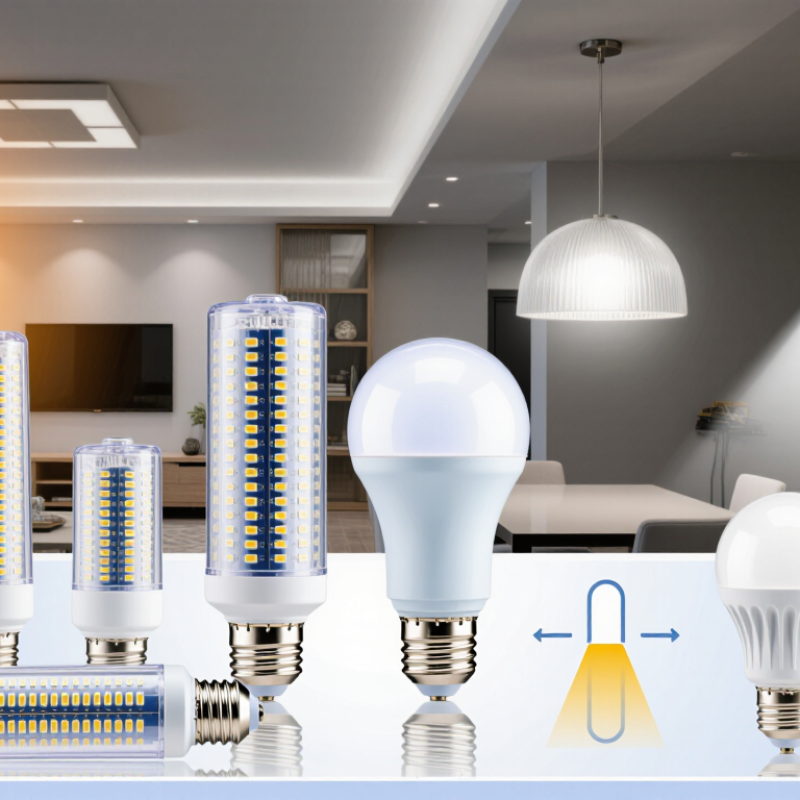
How to Choose a Dimmable LED Corn Bulb in 2026?

Set Required Lumens Using the 80–150 lm/W LED Efficacy Benchmark

When choosing a dimmable LED corn bulb in 2026, set lumens before checking wattage. The 80–150 lm/W benchmark offers a practical starting point for estimating efficiency. A 6,000-lumen replacement may require roughly 40–75 watts, depending on thermal design and driver performance. Real installations are messier.

The U.S. Department of Energy’s 2023 Solid-State Lighting R&D Opportunities report shows that LED efficacy can exceed 200 lm/W under controlled laboratory conditions. That figure is not a promise for a complete corn bulb. Heat, optics, diffuser losses, and dimming electronics reduce delivered output. The International Energy Agency also identifies efficient LED lighting as a major route for reducing electricity demand, but efficiency still depends on correct application.

A mistake I often see is selecting watts first. Choose the target brightness instead. For a small warehouse aisle, 4,000–6,000 lumens may be adequate; taller spaces can need 8,000 lumens or more. Check whether the listed lumens are initial or maintained. This detail matters.

At 100 lm/W, a 6,000-lumen bulb needs about 60 watts. At 140 lm/W, it needs around 43 watts. The benchmark is useful, but not sacred. Confirm dimmer compatibility, minimum-load behavior, beam spread, and enclosed-fixture temperature ratings. A bulb that dims poorly wastes the specification sheet.
How to Choose a Dimmable LED Corn Bulb in 2026?

Estimated input wattage required to achieve common light-output targets at LED efficacies of 80, 115, and 150 lm/W. Lower wattage indicates higher efficacy.

How to use this chart: Select the lumen output needed for the space, then compare the expected wattage range. For example, a 1,600-lumen bulb may require approximately 20 W at 80 lm/W, 13.9 W at 115 lm/W, or 10.7 W at 150 lm/W. Actual performance may vary with optics, thermal design, driver losses, and dimming level.

Match Base, Voltage, Beam Angle, and 360° Corn-Bulb Coverage

How to Choose a Dimmable LED Corn Bulb in 2026?

Choosing a dimmable LED corn bulb starts with the socket. Match the bulb base, such as E26 or E27, before checking brightness. A loose fit can cause flickering or heat buildup. Confirm the fixture voltage too. Many household fixtures use 120 volts, while commercial systems may require a different rating. Never assume compatibility from appearance alone. The bulb should also work with your dimmer. Older dimmers may create buzzing, uneven brightness, or a limited dimming range.

Tips: Check the fixture label, socket depth, and dimmer compatibility. Measure twice. Also inspect whether the fixture is enclosed. Some bulbs need open airflow, and heat can shorten their useful life.

Beam Angle and Light Distribution

Beam angle controls how evenly the bulb fills a room. A wide angle suits garages, workshops, and ceiling fixtures. A narrower angle can direct stronger light toward aisles or work surfaces. For 360° corn-bulb coverage, look for evenly spaced LED panels around the body. More panels do not always mean better illumination. I once selected a very wide bulb, but its shade blocked the lower light. That mistake reminded me to assess the fixture, not only the bulb. Compare the bulb’s shape, panel placement, lumen output, and actual installation position before buying.

Verify TRIAC, 0–10 V, or PWM Dimming Compatibility and 10–100% Range

How to Choose a Dimmable LED Corn Bulb in 2026?

A dimmable LED corn bulb is not automatically compatible with every dimmer. Check the driver label for TRIAC, 0–10 V, or PWM support. TRIAC dimming cuts the AC waveform, while 0–10 V uses a separate low-voltage control pair. PWM rapidly switches current to reduce perceived brightness. They are different systems. Never assume one method can replace another.

Ask for a tested dimming range from 10% to 100%. Many products dim smoothly only from 20% upward. That gap matters in bedrooms, restaurants, and display areas. The U.S. Department of Energy reports that LEDs can use at least 75% less energy than incandescent lighting and last much longer. However, poor dimming can create flicker, audible buzzing, or sudden shutoff. Energy savings alone do not prove control quality. Check results at 10%, 25%, 50%, and 100% output.

Look for compatibility tables, minimum-load requirements, and installation notes. For TRIAC systems, confirm forward- or reverse-phase support and neutral-wire requirements. For 0–10 V systems, verify sink current and polarity. For PWM systems, confirm the control voltage and frequency. NEMA LSD 49 explains that dimming performance depends on the complete control system, not the lamp alone. That is easy to overlook. Ask for flicker measurements using recognized methods, such as PstLM and SVM. Real installations can behave differently from laboratory tests, so a short site trial remains worthwhile.

Compare CRI 80+, CCT 2700–5000 K, and Flicker Performance

When choosing a dimmable LED corn bulb in 2026, begin with color quality. CRI 80+ is a practical minimum for garages, workshops, and utility rooms. It shows reds and skin tones reasonably well, but it does not guarantee natural color. Look for strong R9 performance when identifying wiring colors, tools, or stored goods. I would not judge CRI from packaging alone. Independent test data is more dependable.

CCT controls the visual mood. A 2700 K bulb gives a warm, amber appearance for hospitality areas. Around 3000–4000 K feels clearer in homes and workspaces. A 5000 K option produces a cool, daylight-like effect for task lighting. Check the fixture’s surroundings first. Mixing different CCT values can make one room look uneven.

Flicker matters. A bulb may appear steady while a phone camera reveals dark bands across the image. Check percent flicker, flicker index, and, when available, Pst LM results. Lower readings generally indicate better visual comfort, especially near rotating tools or cameras. Confirm that the dimmer supports the bulb’s wattage and control method. Test the lowest setting in person. Some bulbs dim smoothly at 80 percent, then jump suddenly near 20 percent. That weakness is easy to overlook. Also watch for buzzing, delayed startup, or color shifts while dimming. These small flaws can matter more than impressive headline specifications.

How to Choose a Dimmable LED Corn Bulb in 2026? - Compare CRI 80+, CCT 2700–5000 K, and Flicker Performance

Selection Profile Typical Application Recommended CCT Minimum CRI Typical Power Range Recommended Dimming Range Flicker Target Color and Flicker Assessment Buying Recommendation
Warm Residential Living rooms, bedrooms, restaurants, and hospitality spaces 2700–3000 K CRI 80+
CRI 90+ preferred for wood, skin tones, and artwork
12–25 W 10–100%, subject to dimmer compatibility Percent flicker: ideally below 5%
PstLM: ≤ 1.0
Produces a soft, warm appearance. Confirm that the bulb remains stable at low brightness without visible shimmer or dropout. Recommended
Neutral General Purpose Kitchens, garages, workshops, corridors, and retail back rooms 3500–4000 K CRI 80+
CRI 90+ for more accurate material and product colors
20–40 W 10–100% Percent flicker: ideally below 5%
Prefer SVM below 0.4
Offers a balanced appearance and good visual clarity. A constant-current driver with a smooth dimming curve is preferable. Recommended
Cool Utility Warehouses, service areas, utility rooms, and security lighting 4000–5000 K CRI 80+ 30–60 W 20–100% Percent flicker: below 10%
PstLM: ≤ 1.0
Cooler light can improve perceived brightness, but it may look harsh in residential spaces. Check operating temperature and heat dissipation. Acceptable
High-Color-Accuracy Retail displays, studios, galleries, salons, and detailed task areas 3000–4000 K CRI 90+
Check R9 when saturated reds are important
15–40 W 20–100% Percent flicker: ideally below 3%
SVM below 0.4 preferred
Provides more faithful color rendering than a basic CRI 80+ lamp. Do not rely on CRI alone; review the complete color-quality specification. Recommended
Low-Cost Basic Dimming Non-critical storage, secondary circulation, and low-use areas 3000–5000 K CRI 80+ 10–30 W 30–100% Percent flicker may exceed 10%
Verify with the manufacturer
May provide acceptable illumination but can show buzzing, dead travel, shimmer, or an uneven dimming curve with incompatible controls. Acceptable with Testing
High-Flicker-Risk Product Any area with cameras, rotating machinery, frequent phone-video use, or sensitive occupants Any CCT CRI 80+ is not sufficient by itself Any wattage Unspecified or unstable below 50% Visible modulation, high percent flicker, or PstLM above 1.0 Color temperature and CRI may look acceptable while temporal light modulation remains uncomfortable or problematic for visual recording. Avoid Unless Verified

How to use this table: Choose the CCT according to the intended atmosphere, select CRI 80+ as the basic threshold, and prefer CRI 90+ where color accuracy matters. For dimmable corn bulbs, verify the compatible dimmer type, minimum load, dimming range, and driver specifications. Flicker figures should be based on measured data; percent flicker, PstLM, and SVM describe different aspects of temporal light modulation and should not be treated as interchangeable.

Check UL/ETL Safety, Thermal Design, and 25,000–50,000-Hour Life

How to Choose a Dimmable LED Corn Bulb in 2026?

A dimmable LED corn bulb should begin with safety, not brightness. Look for a genuine UL or ETL certification mark on the bulb or packaging. Then verify the exact model in the testing organization’s online directory. A printed logo alone proves little. Check the voltage, wattage, base size, and fixture rating before installation. Some bulbs are not approved for enclosed fixtures. Others may require a compatible LED dimmer.

Thermal design strongly affects performance. A corn bulb packed with LEDs needs a clear path for heat. Aluminum housing, open vents, and space around the bulb can help. Dusty fixtures and hot ceiling enclosures work against it. Keep the bulb away from insulation unless its instructions allow contact. Poor cooling may cause flicker, early dimming, or a shortened service life. It is easy to overlook this detail.

Rated life commonly falls between 25,000 and 50,000 hours. That number usually reflects controlled testing, not every real room. Heat, frequent switching, and unstable dimming can reduce it. A 50,000-hour rating is not a guarantee. It is a useful comparison point. I would also test the bulb at low, medium, and full brightness. Watch for buzzing, visible flicker, or uneven light. My own checklist is imperfect, but this small test often reveals problems that specifications hide.

Get In Touch

Drop Us A Message

    Our Contact Details

    • IPS Group BV | Head Office (NB), Technopol 4, 5026 SB Tilburg, The Netherlands

      IPS Group BV | Rhijnspoor 239, 2901 LB Capelle a/d IJssel, The Netherlands
    • sale@qbhardware.org
    • +31 (0) 10 303 2625