How to Choose Tech Rosewood Acoustic Slat Panels?
Choosing a Tech Rosewood Acoustic Slat Panel requires more than matching wall colors. It demands careful attention to sound control, material performance, installation conditions, and long-term maintenance. Industry analyses from Grand View Research and MarketsandMarkets report continued growth in the global acoustic panels market, driven by offices, hospitality spaces, education facilities, and home studios. This growth reflects a practical concern: noisy rooms reduce concentration, speech clarity, and perceived comfort.
Performance must come before appearance. A qualified buyer should examine the panel’s Noise Reduction Coefficient, sound absorption class, slat spacing, backing material, fire rating, and formal test documentation. ISO 354 evaluates sound absorption in reverberation rooms, while ISO 11654 supports acoustic classification. These standards do not make every product equal. Installation also changes results. A 45-millimeter air gap may improve low-frequency absorption, but only when the wall structure and mineral wool backing support that design.
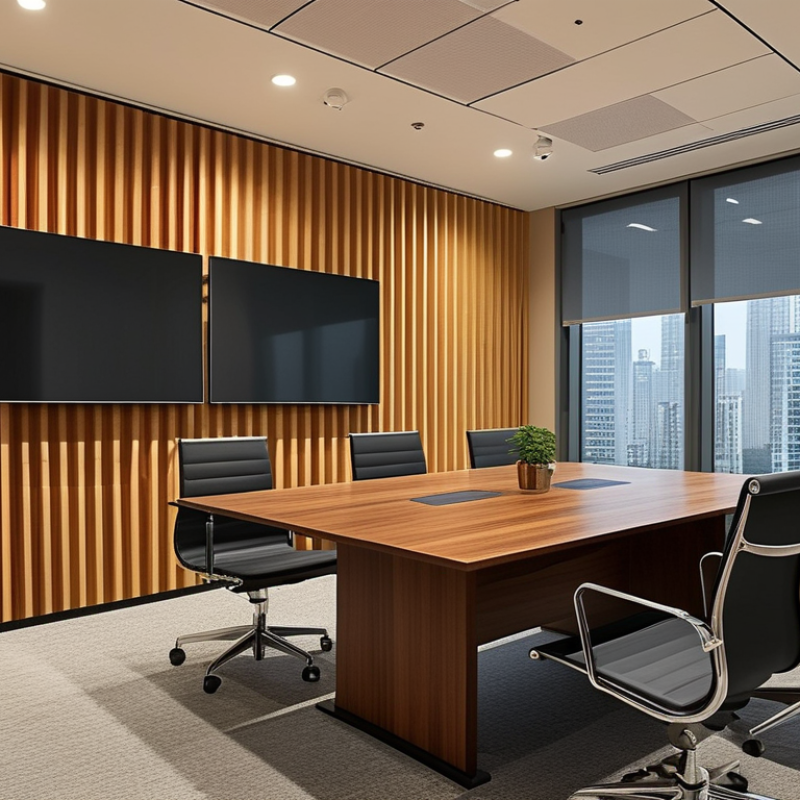
Visual warmth still matters. Rosewood tones can make a reception desk, meeting room, or media wall feel calmer and more refined. However, color consistency may vary between production batches. That detail is easy to overlook. Check samples under the actual room lighting, not only on a monitor. WELL Building Standard guidance also recognizes acoustic comfort as part of healthier interior environments, although certification depends on broader project requirements. The best choice balances verified acoustic data, responsible material sourcing, cleaning needs, and installation skill. No panel fixes every noise problem. Sometimes, room geometry is the real issue.
Define Tech Rosewood Slat Panels: PET Felt, Veneer, Slat Spacing, and Core
When choosing Tech Rosewood acoustic slat panels, define the construction before judging the surface. Tech Rosewood usually describes a technical wood-look finish, not solid rosewood. The visible layer may be natural veneer or a printed decorative film. Veneer offers authentic grain and small tonal variations. Printed finishes provide more consistent color and easier batch matching.
PET felt forms the acoustic backing behind the slats. It absorbs reflected sound, especially when installed with an air gap. Check its density, thickness, recycled content, and fire-performance documentation. Do not trust the word “acoustic” alone. A test report should identify the product assembly, not just the felt material. The core also matters. Stable plywood or engineered board supports screw holding and reduces panel movement. Low-quality cores may swell near damp walls.
Slat spacing controls both appearance and sound behavior. Narrow gaps create a calmer, denser rhythm. Wider gaps expose more felt and can improve sound absorption across certain frequencies. A practical starting point is a 13 to 15 millimeter gap, but room use should guide the choice. Offices, music rooms, and restaurants produce different noise patterns. I once selected a panel by color alone, and the room still sounded harsh. That mistake showed me that installation height, wall coverage, and ceiling reflections matter equally. Ask for spacing drawings, core details, and laboratory results before ordering. Small gaps can also collect dust. That detail is easy to overlook.
Set Acoustic Targets: Compare NRC Ratings from 0.35 to 0.85
Choosing Tech Rosewood Acoustic Slat Panels should begin with measurable acoustic goals, not wood appearance. NRC, or Noise Reduction Coefficient, indicates average sound absorption across key mid frequencies. A panel rated 0.35 offers modest control. It may suit a quiet hallway or furnished study. Ratings near 0.85 absorb much more reflected sound. They may work better in meeting rooms, studios, restaurants, and busy offices. Not silence.
Check the full test report, not only the product label. NRC can change with panel spacing, backing thickness, mounting method, and air gaps. A slatted surface over 50 millimetres of mineral wool usually performs differently from slats fixed directly to drywall. Look for results at 250, 500, 1000, and 2000 hertz. Speech-heavy rooms need balanced absorption in these bands. Low-frequency rumble may require thicker treatment. Measure first. Note the room’s dimensions, hard surfaces, occupancy, and current echo. A phone recording can reveal problems, but it cannot replace professional testing.
Use 0.35 when you want light acoustic softening and visual warmth. Choose 0.65 to 0.85 when voices remain harsh after furnishing. Leave some reflective surfaces; an over-treated room can feel strangely flat. This is easy to overlook. Compare two sample assemblies in the actual room before ordering. One test may expose an uncomfortable truth: the highest NRC option is not always the best fit. Check fire classification, installation tolerances, and maintenance needs alongside acoustic data. A polished finish cannot compensate for weak installation or unsuitable testing conditions.
Choose Panel Dimensions, Slat Geometry, and 25–50 mm Air Gaps
How to Choose Tech Rosewood Acoustic Slat Panels?
Choose Panel Dimensions, Slat Geometry, and 25–50 mm Air Gaps
Start with the room, not the finish. Measure wall height, width, sockets, doors, and ventilation points before selecting panel dimensions. Standard panels install faster, but custom sizing can reduce narrow cuts around corners. I once chose full-height panels without checking a ceiling trim. The final cut looked acceptable, not excellent.
Slat geometry changes both appearance and acoustic behavior. Narrow slats create a finer rhythm, while wider slats produce a calmer, heavier visual effect. Check slat depth, spacing, and the thickness of the felt backing. Uneven gaps may become obvious under strong side lighting. Measure twice.
A 25–50 mm air gap behind the panel can improve sound absorption, especially when paired with suitable mineral wool or another tested acoustic backing. The larger gap is not automatically better. Room size, wall construction, and target frequencies still matter. Low-frequency noise often needs more depth than ordinary speech reflections. Not always.
For panel dimensions, consider handling as well as coverage. Long panels may create fewer joints, but they can be difficult to carry through stairways. Confirm the declared acoustic test results, installation method, surface durability, and fire performance documentation. Do not rely on appearance alone. Samples reveal color variation, edge quality, and how the rosewood tone changes under warm or cool lighting. Details matter.
Verify Fire, Formaldehyde, VOC, and Moisture Standards Before Purchase
How to Choose Tech Rosewood Acoustic Slat Panels?
A convincing wood finish is only the beginning. Before purchase, request current fire-test documents for the complete panel system. The report should identify the core, surface, backing, thickness, and installation method. A certificate for a different substrate may not protect your project. Check the required fire classification in your region, especially for corridors, offices, restaurants, and public interiors.
Formaldehyde and VOC results deserve equal attention. Ask for laboratory test reports, not vague claims such as “eco-friendly.” Confirm the emission limits, test chamber method, and report date. A low-VOC adhesive can still perform poorly beside a high-emission backing. Moisture matters too. Check the panel’s moisture range, storage instructions, and recommended acclimation period. Warped slats often reveal rushed installation, not just bad luck.
Tips: Keep a sample panel in the project room for several days. Look for swelling, odor, color changes, and loose felt. Ask whether fire, formaldehyde, VOC, and moisture results apply to the exact product configuration. In practice, buyers sometimes focus on the rosewood appearance and forget the hidden layers. That mistake is understandable, but expensive. Compare documents with the installer’s method, because laboratory conditions rarely match a dusty, humid site. Ask clear questions, record the answers, and reconsider any supplier who avoids specific evidence.