
How to Choose the Best China AGV Chassis?

Choosing the best China AGV Chassis is not simply a matter of comparing prices online. It requires practical knowledge of payloads, floor conditions, navigation methods, and daily operating cycles. A warehouse may need to carry 500 kilograms across smooth concrete, while a factory chassis faces oil, dust, ramps, and narrow aisles. Small details matter. Wheel diameter, turning radius, battery access, and mounting points can affect the entire vehicle design.

Reliable selection begins with verified technical evidence. Review motor specifications, rated load capacity, suspension structure, controller compatibility, and emergency-stop design. Ask suppliers for drawings, test records, component brands, and clear warranty terms. Experienced manufacturers should explain how the Agv Chassis performs under continuous movement, uneven floors, and repeated stopping. Site testing remains valuable. A specification sheet cannot reveal every vibration, cable issue, or charging delay.

No chassis fits every application. Early requirements may also be incomplete. That is normal. A careful buyer should measure aisle width, floor gaps, ramp angles, and real load distribution before ordering. It is wise to test a sample under working conditions, not only in a showroom. Compare at least two suppliers, but avoid judging by cost alone. A cheaper frame may create expensive integration work later. China offers many capable AGV chassis manufacturers, yet quality varies between models and production batches. Traceable manufacturing, responsive engineering support, and honest communication usually matter more than impressive marketing language. The final choice should balance performance, maintainability, safety, and long-term reliability. Painfully practical, but necessary.
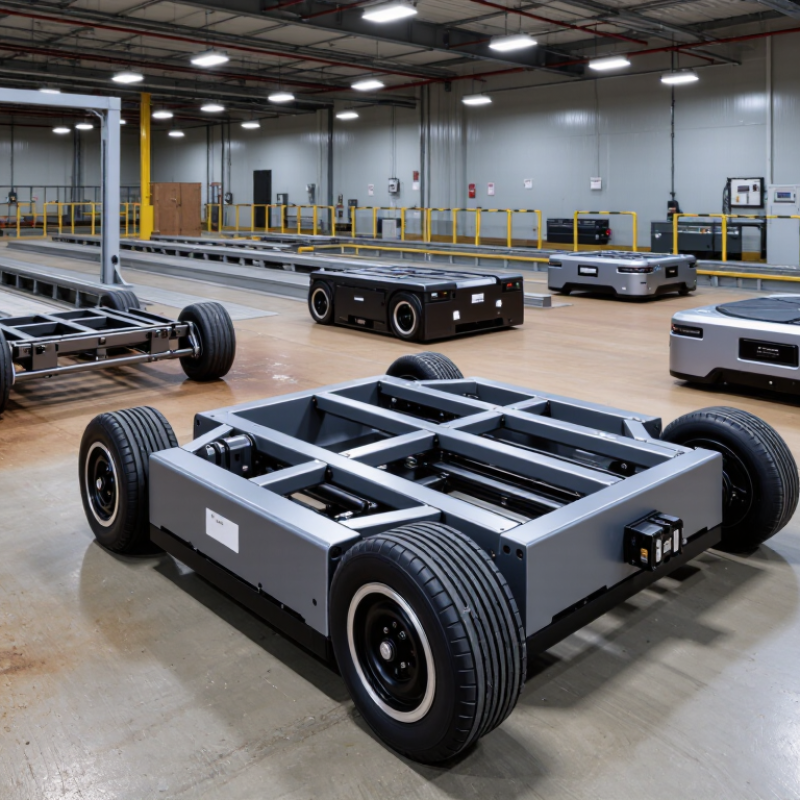
How to Choose the Best China AGV Chassis?

Define 500–2,000 kg Payload, 0.8–1.5 m/s Speed, and Duty-Cycle Needs

How to Choose the Best China AGV Chassis?

Start with the real payload, not the advertised maximum. A 500 kg chassis may fail when the pallet, fixture, battery, and load reach 650 kg. For a 2,000 kg mission, calculate axle loading, braking distance, floor joints, and turning stress. The chassis should maintain stable control at 0.8–1.5 m/s, including loaded starts and emergency stops. ISO 3691-4 highlights risk assessment, detection, and safe speed control for driverless industrial trucks. These points matter more than a high headline speed.

Duty cycle defines the chassis more accurately than daily distance. Record load weight, travel meters, stops per hour, charging windows, and operating hours. A 1,000 kg vehicle running 1.2 m/s may need stronger thermal management if it stops every 20 seconds. IFR’s World Robotics 2024 report recorded about 113,000 professional transport and logistics robots sold in 2023, showing how demanding this sector has become. Yet market growth does not guarantee suitability.

Test it on the actual floor. Small gaps expose weak suspension. Wet dust changes wheel traction. Battery capacity should cover the planned shift with reserve, not optimistic laboratory figures. I have seen teams choose motors from peak torque alone; that was incomplete. Continuous torque, gearbox efficiency, encoder accuracy, and braking heat deserve equal attention. A practical pilot should run several full duty cycles with the maximum payload. Real floors are rarely perfect.

How to Choose the Best China AGV Chassis? - Define 500–2,000 kg Payload, 0.8–1.5 m/s Speed, and Duty-Cycle Needs

Selection Dimension Light-Duty Chassis Medium-Duty Chassis Heavy-Duty Chassis Recommended Evaluation Criteria
Rated Payload 500–800 kg 800–1,400 kg 1,400–2,000 kg Select a chassis with at least 15–20% reserve capacity above the maximum combined load.
Typical Maximum Speed 0.8–1.0 m/s 1.0–1.3 m/s 1.0–1.5 m/s Confirm that the speed is achievable with the intended payload, floor condition, turning radius, and safety limits.
Recommended Operating Pattern Intermittent transport and short routes Regular multi-shift material movement Continuous or high-throughput industrial transport Match the chassis to actual traffic volume rather than maximum speed alone.
Duty Cycle Up to 8 hours/day, moderate movement 8–16 hours/day, repeated cycles 16–24 hours/day, high utilization Ask for motor, gearbox, battery, and thermal ratings under the expected duty cycle.
Drive Configuration Two-wheel differential or compact four-wheel drive Four-wheel drive with independent suspension or load support Heavy-duty four-wheel drive, multi-wheel, or reinforced differential drive Check traction, wheel load, slip control, and the ability to rotate or turn within the available aisle.
Floor Requirements Smooth, level industrial floor; small joints acceptable Level concrete or coated floor with controlled joints Reinforced floor capable of supporting concentrated wheel loads Verify flatness, slope, expansion joints, thresholds, debris, and allowable wheel pressure.
Turning Performance Suitable for tight aisles and small work areas Suitable for standard warehouse aisles Requires larger turning area unless omnidirectional drive is used Compare chassis length, width, minimum turning radius, and loaded turning stability.
Battery Capacity Planning Approximately 2–5 kWh, depending on drive time and accessories Approximately 5–12 kWh for longer routes and multi-shift use Approximately 10–25 kWh or opportunity charging for intensive operation Size the battery from route length, payload, acceleration, slope, idle time, and charging strategy.
Braking and Safety Electronic braking with protective bumpers and emergency stop Regenerative or friction braking with safety scanners Redundant braking, load-aware control, and configurable safety zones Evaluate stopping distance at maximum speed and payload, including wet or contaminated floors.
Load Center Consideration Often designed around a 400–600 mm load center Typically requires load-center verification around 600 mm May require customized support for loads beyond 600 mm Do not judge capacity by weight alone; confirm load dimensions, center of gravity, and overhang.
Best-Fit Applications Kitting, light pallet movement, line-side delivery, and small carts Pallet transport, warehouse replenishment, assembly-line feeding, and towing Heavy pallets, steel components, battery packs, molds, and production transfer Choose the smallest chassis that satisfies capacity, stability, route, and utilization requirements.
Key Questions for Supplier Validation Can the chassis maintain rated performance at the specified payload? What are the continuous motor ratings, wheel loads, gradeability, stopping distance, charging time, ingress protection, spare-parts availability, and test conditions? Request test data using your actual payload, route, floor conditions, speed profile, and operating schedule.

Practical rule: Define the maximum payload, target speed, route conditions, and daily operating hours first. Then select the chassis using continuous-duty performance and safety margins, not only the advertised peak specifications.

Verify ±10 mm Docking Accuracy and ISO 3691-4:2020 Safety Functions

How to Choose the Best China AGV Chassis?

Docking accuracy should be verified, not simply advertised. A ±10 mm claim may look precise, but it is not automatically repeatable. Test the chassis with its real payload, battery level, floor condition, and approach speed. Record at least 30 docking cycles. Measure lateral error, stopping distance, and connector alignment. The IFR World Robotics 2024 report recorded more than 205,000 professional service robots installed in 2023, with transport and logistics among the largest applications. This growth makes measurable chassis performance increasingly important.

Safety evidence matters as much as navigation data. ISO 3691-4:2020 addresses driverless industrial truck safety, including speed control, protective detection fields, emergency stops, and warning functions. Ask the supplier for test records mapped to each applicable function. Observe reduced-speed operation near people. Check whether safety inputs stop motion reliably after power interruptions. A chassis can pass a demonstration and still fail in a narrow aisle. That uncomfortable possibility deserves testing.

Tips: Request a floor plan, error map, and raw docking records. Test reflective surfaces, uneven joints, and blocked sensors. Confirm safety distances for your maximum speed. Do not accept “ISO compliant” without a documented risk assessment. Also question your own test design; one clean shift proves very little.

Match LiFePO₄ Batteries to 8–12 Hours of Operation and 2–3 Hours Charging

How to Choose the Best China AGV Chassis?

For 8–12 hours of AGV operation, battery matching should begin with real energy demand, not marketing capacity. A LiFePO₄ battery needs enough usable energy for the chassis, controller, sensors, payload, and movement losses. Measure average power during loaded travel, waiting, turning, and ramp climbing. Then add a practical reserve of 15–20%. That reserve matters when floors are uneven or temperatures fall.

Charging time is equally important. A 2–3 hour charging window requires a compatible charger, battery management system, and sufficient electrical input. For example, a vehicle working two shifts may charge during meal breaks or scheduled handovers. Check the charger’s voltage, current, communication method, and cooling requirements before choosing the chassis. Fast charging can increase heat and battery stress if the system lacks proper control.

A common mistake is trusting laboratory runtime. Real warehouses include traffic delays, repeated starts, heavy loads, and imperfect routes. The advertised figure may be wrong. Test a loaded chassis on the actual floor, preferably for several cycles. Review battery temperature, voltage drop, charging recovery, and remaining capacity. LiFePO₄ chemistry offers stable performance and good cycle life, but it still needs correct protection settings. Leave space for battery access, cable inspection, and future replacement. Small chassis dimensions can create large maintenance problems.

Check VDA 5050, CE, EMC, and China GB/T Compliance Before Integration

How to Choose the Best China AGV Chassis?

Before integration, check whether the chassis supports VDA 5050 at the required version. This interface standard helps fleet software exchange orders, states, and navigation data. It does not prove mechanical safety or reliable operation.

Confirm message timing, error handling, map behavior, and recovery after a network drop. The International Federation of Robotics reported roughly 113,000 professional transportation and logistics robots sold in 2023. That growth increases integration pressure. A weak interface can turn a small software gap into warehouse downtime.

CE compliance also requires careful reading. CE marking depends on the applicable European directives, risk assessment, technical file, and declaration of conformity. EMC testing should cover emissions and immunity under realistic conditions. Test the motors, charging system, wireless equipment, and emergency-stop circuit together.

China GB/T compliance needs the same discipline. Ask for current test reports, applicable standards, traceable component records, and Chinese-language technical documentation. Requirements may differ for the chassis, battery, charger, and radio module.

In practical evaluations, place the chassis on a marked test route. Add metal racks, reflective floors, ramps, and a temporary wireless dead zone.

Measure stopping distance, localization recovery, charging behavior, and fault reporting.

Reports from Interact Analysis forecast continued expansion in warehouse mobile robotics, but market growth does not guarantee product maturity. I have seen documentation look complete while recovery logic remained unclear. That is an uncomfortable finding.

Choose the chassis only after compliance evidence and integration tests agree. Divergence between the two deserves a written risk decision.

Compare MTBF, Warranty Terms, Spare Parts, and 3–5-Year Total Cost of Ownership

How to Choose the Best China AGV Chassis?

China’s AGV chassis market is expanding with industrial automation. IFR’s World Robotics 2024 reported 541,302 industrial robots installed worldwide in 2023. However, a large market does not guarantee reliable mobile platforms.

Compare MTBF under similar loads, speeds, floor conditions, and duty cycles. A chassis rated for 20,000 hours may use laboratory conditions. Ask for test methods, failure definitions, and repair records.

MTBF alone can mislead.

Warranty terms deserve equal attention. Check whether coverage includes motors, encoders, batteries, controllers, and labor. A one-year warranty may look attractive, but five-year parts availability can matter more.

Request prices for wheels, drive modules, sensors, and batteries. Calculate three-year and five-year TCO: purchase, integration, spare parts, maintenance, energy, software fees, and downtime.

A low-price unit can become expensive after repeated wheel failures. I have seen spreadsheets ignore lost production hours. That is a serious weakness.

Tips: Test one chassis for 30 days.

Use a weighted trolley on real flooring. Record charging time, wheel temperature, fault codes, and recovery time.

The MHI 2024 Annual Industry Report highlights labor pressure as a major automation driver, but automation still requires skilled maintenance.

Keep critical parts locally or define delivery times contractually. Also, do not trust every impressive MTBF claim.

Independent endurance testing costs money, yet weak validation costs more. A practical buyer should compare failure history, warranty exclusions, and actual service response before approving a three-to-five-year investment.

Get In Touch

Drop Us A Message

    Our Contact Details

    • IPS Group BV | Head Office (NB), Technopol 4, 5026 SB Tilburg, The Netherlands

      IPS Group BV | Rhijnspoor 239, 2901 LB Capelle a/d IJssel, The Netherlands
    • sale@qbhardware.org
    • +31 (0) 10 303 2625