China Best Welding Positioners for Global Buyers?
Finding the best Welding Positioners in China is not simply a matter of comparing prices. Buyers need equipment suited to their workpieces, production volume, and workshop layout. A compact tilting positioner may fit a small fabrication shop, while heavier assemblies can require greater load capacity and a wider working range. Details matter. Rotation speed, table diameter, adjustment method, and control options all affect daily use.
A reliable comparison starts with clear requirements. Confirm the workpiece’s weight and dimensions, then ask suppliers how they calculate rated capacity, including any offset load. Request technical drawings, operating instructions, warranty terms, and information about spare parts. If possible, review a live demonstration or arrange an independent inspection before shipment. These checks help separate documented performance from attractive catalog claims. They also make it easier to compare suppliers on consistent criteria.
Price still matters, but low initial cost may not reflect the full ownership expense. Consider installation, operator training, maintenance access, and the availability of replacement components. Ask specific questions about quality checks and how faults are handled. Responses should be clear and supported by records, not just promises. No single supplier is best for every buyer. Even a detailed checklist can miss a practical issue, such as limited space around the machine. Careful verification, realistic requirements, and direct communication give global buyers a stronger basis for choosing Chinese Welding Positioners that fit their production needs.
Welding Positioners Explained: Their Role Across the 6 AWS Groove-Weld Positions
A welding positioner can turn a difficult joint into a more manageable one, but it does not change the joint’s AWS position classification. AWS A3.0 describes groove-weld positions including 1G (flat), 2G (horizontal), 3G (vertical), and 4G (overhead); pipe work also commonly uses 5G and 6G.
A positioner rotates or tilts the workpiece so the welder can maintain a steadier torch angle and control the weld pool. That matters when a seam wraps around a cylindrical part. Small changes in tilt can affect visibility and access.
For rolled pipe, a positioner may keep the weld near the flat position. Fixed 5G pipe requires welding around a horizontal pipe, while fixed 6G pipe sits at a 45-degree angle and demands work across changing orientations.
A fixture cannot solve every problem. Root gap, joint preparation, and clearance still matter. Easy to overlook.
The American Welding Society’s 2023 Welding Workforce Data report projected that the industry would need about 360,000 new welding professionals by 2027, underscoring the value of repeatable setups and practical training. That is a projection, not a measure of actual hires.
Buyers should match positioner capacity and rotation range to the component, then verify the setup with a qualified welding procedure and test weld.
Types of Chinese Welding Positioners: 2-Axis Tables, Headstock-Tailstock, and Rolls
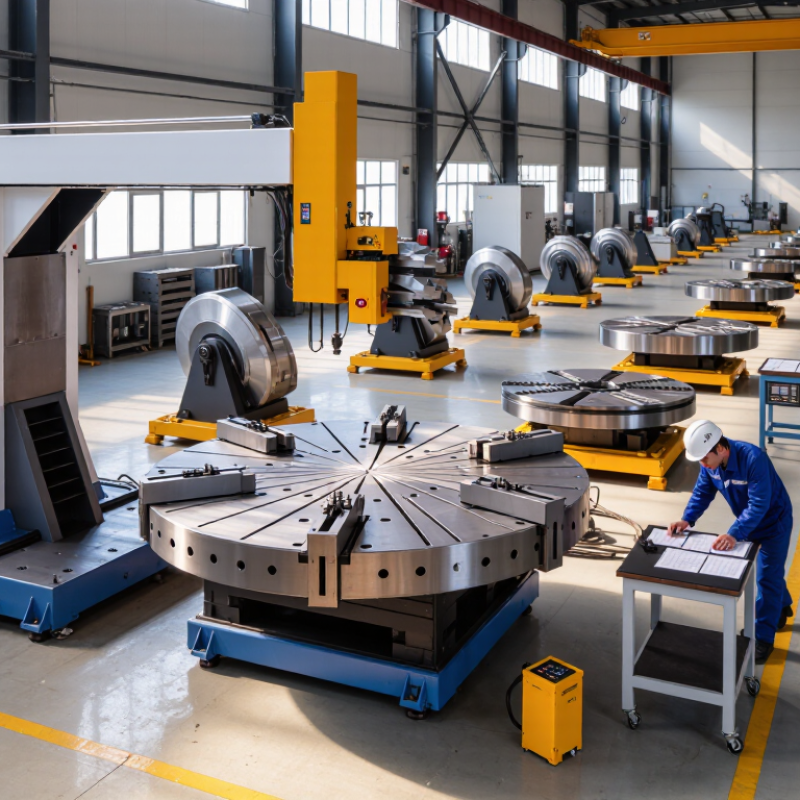
Chinese welding positioners generally fall into three practical groups: 2-axis tables, headstock-tailstock units, and turning rolls. A 2-axis table rotates and tilts compact parts, helping operators keep fillet welds near a comfortable flat position. Check the rated load at the actual offset, not just the headline capacity. A heavy fixture can shift the centre of gravity quickly. Fit matters.
Headstock-tailstock positioners support long shafts, frames, or vessels between two ends. Buyers should verify spindle alignment, tailstock travel, and whether the workpiece can be loaded safely. Turning rolls rotate cylindrical shells and pipes; matched roller speeds and suitable wheel spacing help prevent slipping or shell distortion. These details are easy to overlook. The International Federation of Robotics reported 541,302 industrial robot installations worldwide in 2023, with 70% installed in Asia (World Robotics 2024). That figure reflects broader automation activity, not positioner sales, so it should not be treated as proof of demand for any specific machine. For a real comparison, request load charts, rotation-speed ranges, runout tolerances, and a trial with a representative workpiece. One awkward truth: catalog specifications rarely show how smoothly a fixture behaves under an uneven load.
China Best Welding Positioners for Global Buyers? Types of Chinese Welding Positioners: 2-Axis Tables, Headstock-Tailstock, and Rolls
Typical powered positioning axes: Two-axis tables combine rotation and tilt. Headstock-tailstock positioners typically rotate a workpiece between supports, while welding rolls rotate cylindrical workpieces. Actual configurations vary by machine and application.
How to Size a Positioner: Load, Center of Gravity, Tilt, and Rotation Speed
Sizing a welding positioner starts with the complete rotating load: workpiece, fixture, clamps, and any cables that move with it. A 500 kg assembly with its center of gravity 120 mm off the rotation axis creates about 588 N·m of static imbalance torque (mass × gravity × offset). Small offsets matter. Add acceleration and stopping forces, then compare the result with the maker’s permitted load and overturning-moment limits; payload alone is not enough. AWS’s Welding Handbook discusses how welding position affects access and process control, but the actual rating must come from the positioner’s technical data and your setup.
Check tilt separately. The center of gravity shifts relative to the tilt axis, so an assembly that rotates comfortably may still demand excessive tilt torque. For rotation speed, match surface travel to the weld procedure: at 0.3 m/min on a 600 mm diameter, the table turns about 0.16 rpm. Confirm that the control can hold this speed smoothly under load. The International Federation of Robotics reported 541,302 industrial robot installations worldwide in 2023; automation is expanding, but that figure does not replace application-specific sizing. A spreadsheet can miss cable drag, uneven fixtures, or sudden starts. Measure the real setup where possible, and leave a documented capacity margin rather than relying on a tidy nominal weight.
China Best Welding Positioners for Global Buyers? - How to Size a Positioner: Load, Center of Gravity, Tilt, and Rotation Speed
Preliminary sizing reference. Select a positioner using the complete workpiece-and-fixture mass, center-of-gravity offset, required tilt range, and welding speed. Figures below are illustrative selection examples, not equipment ratings.
| Illustrative rated load | Example maximum CG offset* | Approx. load moment at offset | Typical rotation-speed range | Tilt range to consider | Example application |
| 100 kg | 100 mm | About 98 N·m | 0.1–1.5 rpm | 0–135° | Small brackets and light fabrications |
| 300 kg | 150 mm | About 441 N·m | 0.1–1.2 rpm | 0–135° | Compact frames and pipe assemblies |
| 500 kg | 200 mm | About 981 N·m | 0.05–1.0 rpm | 0–135° | Medium frames, tanks, and weldments |
| 1,000 kg | 250 mm | About 2,453 N·m | 0.05–0.8 rpm | 0–135° | Large frames and industrial assemblies |
| 2,000 kg | 300 mm | About 5,886 N·m | 0.03–0.6 rpm | 0–135°; confirm under full load | Heavy fabricated structures and large components |
Sizing notes: Include the fixture, clamps, and workpiece in the total load. Estimate static load moment as mass (kg) × 9.81 m/s² × horizontal CG offset (m). For example, 500 kg at 0.20 m produces approximately 981 N·m. Actual allowable offset, tilt capacity, and speed depend on the specific machine design, load distribution, duty cycle, and mounting arrangement; confirm them with the equipment supplier before selection.
*CG offset is measured from the rotation axis to the combined center of gravity. The example values are planning assumptions, not universal limits.
How ISO 3834’s 3 Quality Levels Help Buyers Assess Welding Suppliers
When comparing welding positioners, buyers should also examine how the supplier controls any welded frames, fixtures, and load-bearing parts. ISO 3834-1:2021 defines three quality-requirement levels: comprehensive, standard, and elementary. ISO 3834-2, -3, and -4 set the corresponding requirements. These levels reflect the product’s complexity and consequences of failure, not a simple ranking of suppliers. Three levels. Different needs.
Ask which level fits the positioner and request evidence: welding procedure specifications, welder qualifications, inspection records, and material traceability. For a heavy-duty positioner, look for clear records linking the steel grade to the finished frame and documenting checks on critical welds. The American Welding Society’s 2023 workforce outlook estimated that the United States would need 330,000 welding professionals by 2028. That estimate highlights why documented competence matters, though staffing figures alone cannot prove a supplier’s workmanship. A certificate is useful, not conclusive. Check its scope, validity, and whether shop-floor records match the equipment being quoted.
How to Compare China-Made Positioners: IEC 60204-1 Safety, Controls, and Service
China-made welding positioners should be compared by safety evidence, control behavior, and service readiness—not price alone. IEC 60204-1 covers electrical equipment of machinery, including protective bonding and control functions. Ask for wiring diagrams, risk assessments, and test records for the exact configuration offered. A general declaration does not prove the complete welding cell meets every local requirement. That distinction matters. The International Federation of Robotics reported 541,302 industrial robots installed worldwide in 2023 in World Robotics 2024. This indicates the scale of industrial automation, but it is not a positioner-specific sales figure.
During a factory acceptance test, rotate a loaded fixture through its full working range. Check for smooth starts, controlled stopping, and unwanted movement after release. Inspect cable routing near rotating joints; tight bends and exposed connectors can become service problems. Test emergency-stop and restart behavior with the supplier, then confirm that pendant labels and operating instructions are clear. Controls should make speed, direction, and rotation limits easy to set. Some checks feel tedious. They can reveal gaps that a specification sheet will miss.
Tips: Request the IEC 60204-1 edition and conformity documents relevant to your project. Confirm spare-part lead times, remote troubleshooting hours, and who handles on-site service. Ask for a sample maintenance checklist. A neat checklist helps, though it cannot replace a technician’s judgment.