
China Best Stainless Steel Kitchen Faucet Manufacturer?

Choosing a China-based manufacturer for a Stainless Steel Kitchen Faucet takes more than comparing photos and unit prices. The right supplier should explain the steel grade, product construction, and finish in clear, verifiable terms. Ask how the faucet is tested for leaks, handle movement, and surface consistency. Small details matter: a loose handle or uneven finish can become obvious after daily use.

A polished catalog is not proof. Request product specifications, current quality documents, and close-up images of the actual model. If possible, inspect a sample and check the weight, edges, hose connections, and feel of the controls. Discuss customization, minimum order quantities, production schedules, packaging, and replacement parts before placing an order. Clear answers can reveal how well a manufacturer manages routine requests and unexpected problems.

No supplier is perfect. A slow reply or an unclear specification deserves a follow-up, not an assumption. Buyers should also confirm that any stated certifications apply to the exact product and destination market; requirements can vary. This guide looks at practical ways to compare Chinese manufacturers, assess product quality, and ask useful questions before choosing a partner. The goal is not to identify a universal “best” factory, but to help readers make a more informed decision based on their own budget, project needs, and quality expectations.
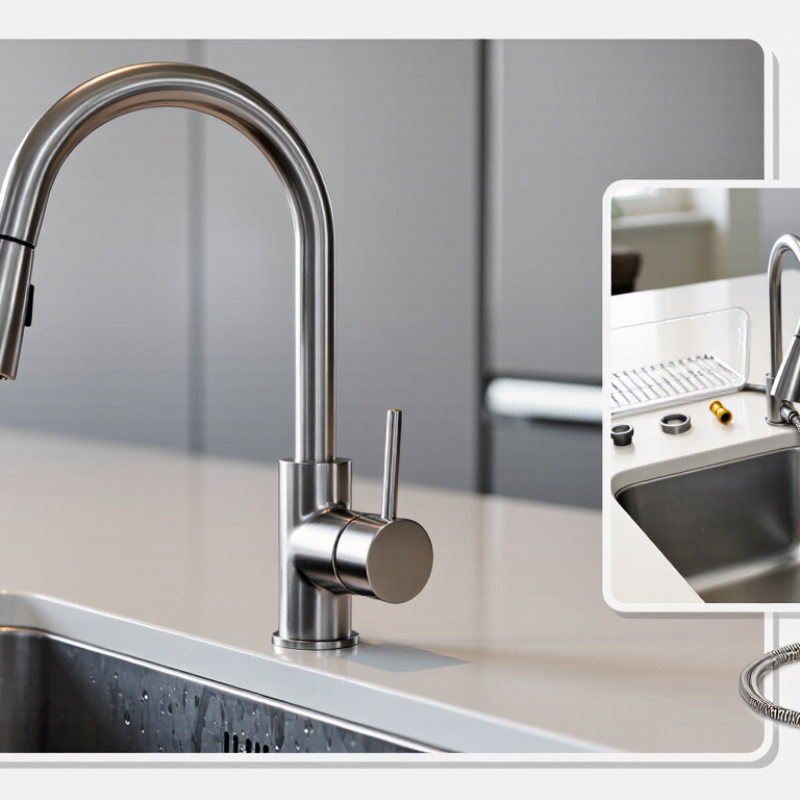
China Best Stainless Steel Kitchen Faucet Manufacturer?

What Defines a Stainless Steel Kitchen Faucet Manufacturer?

What Defines a Stainless Steel Kitchen Faucet Manufacturer?

A capable manufacturer does more than shape steel and assemble a spout. It controls material traceability, machining tolerances, surface finishing, cartridge fit, and leak testing.

The World Stainless Association reported 58.4 million tonnes of global stainless steel production in 2023. That scale makes material choice important: buyers should ask for the stated alloy grade and supporting mill documentation, not rely on a polished finish alone. A handheld XRF check can help verify alloy composition, though it does not replace full material records.

For drinking-water contact, request applicable NSF/ANSI 61 and NSF/ANSI 372 certification details, then confirm the exact faucet model and scope. Ask how the factory tests flow, pressure, and repeated handle operation; request written procedures or sample inspection records. A useful supplier should explain these checks clearly. Claims are easy. Repeatable evidence is harder. I would still inspect production samples, because a good certificate cannot reveal every weak joint or uneven finish.

Tips: Check the underside of the spout and handle for rough edges, uneven plating, or loose movement. Ask for spare-part availability and warranty terms in writing. A low price may be attractive, but unclear testing deserves a closer look.

How Stainless Steel Kitchen Faucets Are Designed and Made

How Stainless Steel Kitchen Faucets Are Designed and Made

A faucet begins with a specification: waterway layout, handle position, spout reach, and material grade. Designers check whether hands can reach the handle easily and whether a large pot fits beneath the spout. Small details matter. Stainless steel is not one fixed recipe; grades differ in composition and corrosion resistance. Manufacturers should verify material records rather than rely on a polished finish alone.

The World Stainless Association reported 58.4 million tonnes of global stainless crude steel production in 2023, up 4.6% from 2022. This shows the scale of supply, not the quality of any individual faucet.

Production methods vary by design. A body may be cast, formed, or machined, then joined to the spout and internal water passages. Workers deburr edges, polish visible surfaces, and clean the parts before assembly. The surface can look flawless while a hidden joint still leaks. That is why factories should test flow, handle movement, and leakage under pressure, using documented inspection steps. It is not glamorous work. Still, it catches faults early.

Designers also need to consider repair access: cartridges and seals may wear, and a faucet that is difficult to service can become wasteful. Even careful processes have limits, so clear material specifications and repeatable testing matter more than appearance alone.

Key Standards for Evaluating Chinese Faucet Manufacturers

China Best Stainless Steel Kitchen Faucet Manufacturer?

Key Standards for Evaluating Chinese Faucet Manufacturers

China’s stainless steel supply base is substantial. The International Stainless Steel Forum’s Stainless Steel in Figures 2024 reports 58.4 million tonnes of global crude stainless steel production in 2023. That figure describes supply, not faucet quality. Ask manufacturers to identify the steel grade and provide traceable material certificates. For a kitchen sink near the coast, chloride exposure may also make corrosion resistance worth checking.

Evaluate documented compliance, not just a polished sample. For North American markets, ask whether the faucet is tested to ASME A112.18.1/CSA B125.1 and whether wetted components meet NSF/ANSI/CAN 61 and lead-content requirements under NSF/ANSI 372. Request test reports tied to the exact model. Then inspect the cartridge, hose connections, aerator, and finish after repeated operation. A showroom unit can look perfect while revealing little about production consistency.

Factory audits should include incoming-material checks, leak testing, and batch records. Ask how defects are logged and what replacement parts remain available. The US Environmental Protection Agency’s Fix a Leak Week materials note that a faucet dripping once per second can waste more than 3,000 gallons annually. Small faults matter. Still, a single audit cannot prove every shipment will match the sample; compare independent test documents with your own pre-shipment inspection.

Major Manufacturing Regions and Industry Capabilities in China

China’s stainless-steel faucet supply chain is concentrated in several manufacturing regions, each with different strengths. Guangdong’s Kaiping–Shuikou cluster is known for faucet casting, polishing, assembly, and component sourcing. Zhejiang’s Taizhou and Wenzhou areas have deep metalworking and valve-making capabilities. Fujian’s Nan’an cluster connects sanitary-ware producers with export-oriented suppliers. These are regional patterns, not guarantees about any individual factory.

The World Stainless Association reported that China produced 36.7 million tonnes of stainless-steel melt-shop output in 2023, roughly 63% of global production. This scale supports broad access to stainless-steel grades and processing services, but it does not prove that every faucet uses suitable material. The National Bureau of Statistics reported 5.0% growth in manufacturing value added that year. Still, automation and quality control vary between suppliers. Not uniformly.

For buyers, regional knowledge helps narrow a search, but factory-level checks matter more. Ask for the steel grade, material traceability, and documented corrosion and leak testing. Inspect the finish around the spout and handle; small pits or uneven polishing can signal inconsistent process control. A factory may outsource cartridges or surface treatment, so clarify who controls those steps. The cluster map is useful. It is not a substitute for a production audit.

How to Choose a Chinese Kitchen Faucet Manufacturer

China Best Stainless Steel Kitchen Faucet Manufacturer?

Choosing a Chinese kitchen faucet manufacturer starts with product details, not a polished catalog. Ask which stainless-steel grade is used for the body, and request material records tied to the quoted model. Confirm wall thickness, cartridge source, finish options, and whether the spray hose has been tested through repeated bends. A sample should match production specifications. Small gaps matter.

Look beyond the sample. Ask how incoming metal, machining dimensions, leak tests, and surface finish are checked on the factory floor. Request recent inspection records, clear production photos, and a written process for handling defects. Then compare lead times, minimum order quantities, packaging protection, and spare-part availability. A low quote may leave out details that affect installation. Test communication with a specific drawing or change request, and note how clearly the team responds. Verify export experience for your destination and request references you can contact. No checklist catches everything. Keep the first order manageable, inspect a pre-shipment unit when possible, and record agreed specifications in writing. A reliable manufacturer should welcome precise questions, though delays still need a realistic plan.

How to Choose a Chinese Kitchen Faucet Manufacturer: Stainless Steel Composition Ranges

These are specified chromium and nickel composition ranges for 304 and 316 stainless steel under ASTM A240/ASME SA-240, shown as weight percentages. When assessing a manufacturer, ask for material specifications and mill test certificates, and confirm that the stated grade matches your product requirements. Composition alone does not establish faucet quality or suitability.

Get In Touch

Drop Us A Message

    Our Contact Details

    • IPS Group BV | Head Office (NB), Technopol 4, 5026 SB Tilburg, The Netherlands

      IPS Group BV | Rhijnspoor 239, 2901 LB Capelle a/d IJssel, The Netherlands
    • sale@qbhardware.org
    • +31 (0) 10 303 2625