2026 Best Garment Labels for Wholesale Buyers
Wholesale buyers selecting Garment Labels in 2026 face a small component with a surprisingly large job. A label must identify a brand, remain readable, and suit the garment’s fabric and intended use. It also needs to arrive consistently, across colors, sizes, and repeat orders. Small details matter.
The scale of material choices adds context. Textile Exchange’s Materials Market Report 2024 estimates that global fiber production reached 124 million tonnes in 2023. The report projects 160 million tonnes by 2030 if current trends continue. These figures describe the wider fiber market, not label demand. Still, they underline why buyers should ask clear questions about label materials and supplier claims. Does the proposed option suit the garment? Can its specifications be documented? Will it stay legible after washing? Ask for samples and test them on the actual product. A polished mock-up is not proof of production performance. That gap is easy to underestimate.
This guide compares woven, printed, satin, cotton, and other common label options for wholesale purchasing. It considers readability, hand feel, durability, customization, minimum order quantities, and lead times. Supplier capabilities vary, so no single label is best for every collection. The right choice depends on the garment, price point, and customer expectations. Some trade-offs remain. A softer label may feel better but provide less visual contrast. Buyers should verify details before approving bulk production.
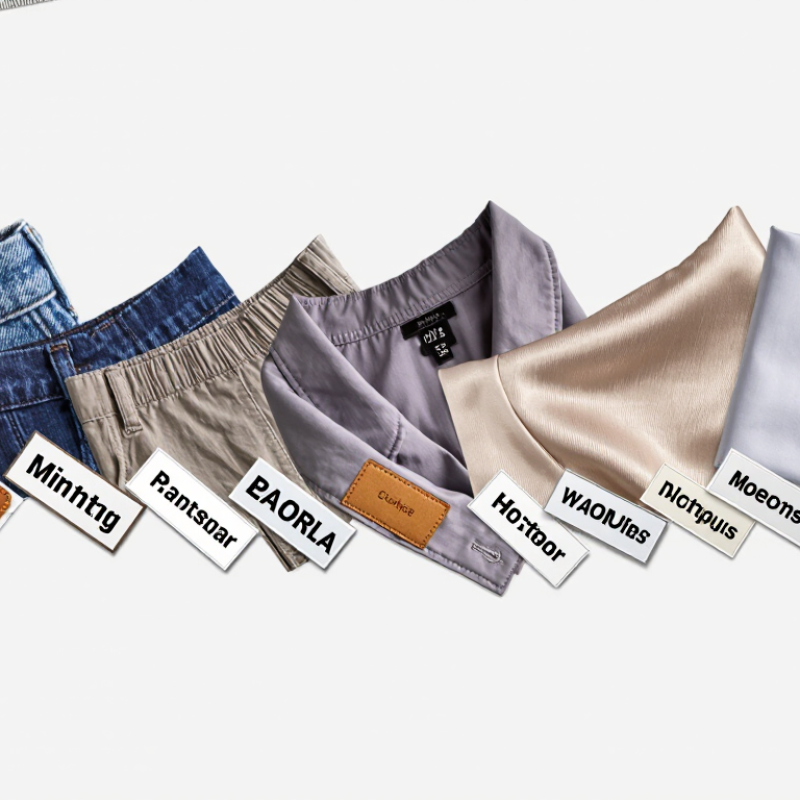
What Garment Labels Are and Why Wholesale Buyers Use Them
Garment labels are the small information points attached to a product: sewn-in care and fiber labels, size tabs, and hangtags. For wholesale buyers, they help teams identify styles, sizes, materials, and care instructions while receiving, sorting, and replenishing stock. A woven size tab can prevent a black medium from being mistaken for a black large. Small details matter. Clear, consistent label specifications also help factories and warehouse staff check that the delivered goods match purchase orders.
The scale of apparel makes reliable product information increasingly useful. Textile Exchange’s Materials Market Report 2024 estimates that global fiber production reached 124 million tonnes in 2023. That figure reflects a complex mix of materials and supply chains. The Ellen MacArthur Foundation’s 2017 report, A New Textiles Economy, found that clothing production doubled from 2000 to 2015, while garment use fell by 36%. These reports do not prove that labels alone improve tracking. They do show why accurate product details matter. When linked to a buyer’s inventory system, a barcode or product identifier can support faster checks and clearer records. I would still verify label placement and print durability on physical samples; a neat specification sheet cannot reveal every production flaw. A label can inform, but it cannot replace quality control.
Which Types of Garment Labels Suit Different Apparel Products
Choosing a garment label starts with the fabric, how the item is worn, and how often it is washed. Soft cotton tees usually suit printed satin or heat-transfer labels because they add little bulk at the neck. For a premium-feel shirt, a woven label adds texture, but stiff edges may irritate sensitive skin. Small details matter.
Sportswear needs a different balance. Lightweight printed labels or carefully placed heat transfers keep seams smooth during movement. However, heat applications can crack or peel if fabric stretches or press settings are unsuitable. Test the actual garment, not just a fabric swatch. Swimwear and underwear often benefit from soft, low-profile labels, while elastic trims may need a label sewn into a side seam.
Denim, jackets, and workwear can carry woven or sturdy printed labels, since heavier cloth supports thicker stitching. A hem or patch label can stay visible without rubbing the neck. For baby clothing, choose soft edges and keep the label small; even a neat seam can feel rough after repeated washing. There is no universal best type. Wash samples, check legibility, and reconsider placement before ordering wholesale quantities.
How Label Materials and Printing Affect Quality and Durability
For wholesale buyers, label material should match the garment’s use, not just its appearance. A soft satin label suits lightweight tops, while woven polyester often holds fine lettering on items that see frequent washing. Cotton labels offer a natural texture, but their edges may feel rough against sensitive skin. Check the label against the fabric and seam where it will be sewn. Small details matter. A sample that feels smooth in the hand may still scratch after a full day of wear.
Printing affects legibility and how well a label handles friction, heat, and laundering. Clear, high-contrast text is easier to read, while very small lettering can blur or close up during production. Ask for a wash-tested sample, then inspect it after several cycles for fading, cracking, curling, or loose threads. Not always. A more durable print may cost more, yet the cheapest option can create rework if care instructions become unreadable. Compare samples under ordinary lighting, and check the actual garment color; a screen preview can be misleading. Even careful testing has limits, so confirm that bulk production uses the same material and print settings as the approved sample.
2026 Best Garment Labels for Wholesale Buyers
How label materials and printing affect quality and durability
Typical moisture regain differs by fiber and can affect dimensional stability and print compatibility. Values are approximate and vary with fiber grade and test conditions. For durable labels, confirm the material and print method together through wash testing.
What to Compare When Selecting a Wholesale Label Supplier
A wholesale label supplier should be judged on repeatable performance, not a polished sample alone. Compare fabric, print method, edge finish, minimum order quantity, lead time, and reordering terms. Ask for wash and rub-test results on the actual label material. Then check small details: Can the care text stay readable after laundering? Do folded labels feel soft against skin? Will barcode scans work across production batches? Small details matter.
Material claims deserve careful review. Textile Exchange’s Materials Market Report 2024 estimates that global fiber production reached 124 million tonnes in 2023, while recycled fibers accounted for 7.7%. That makes clear, verifiable composition information useful when labels support sourcing claims. Request documentation linking the label wording to its evidence, plus approval samples and batch records. A label alone does not prove a garment’s full supply-chain history.
Traceability has limits. The Ellen MacArthur Foundation’s A New Textiles Economy report estimated that less than 1% of material used to produce clothing was recycled into new clothing. Durable labels cannot solve that system-wide problem, but accurate fiber details can help preserve useful product information. Compare suppliers on documentation, defect handling, and capacity during peak orders. One candid caveat: a low unit price may still cost more if reprints, delays, or inconsistent color appear later. Ask how those issues are measured, not just promised.